

🧮 Grade 5 Math · Term 1 · Egyptian curriculum

Grade 5 Math games, Term 1: the Treasure Islands

Free games for the whole Grade 5 Math book (Term 1, Egyptian curriculum), in English or Arabic: all 6 units, lesson by lesson, with the book's own questions. Every island is a unit of the book, and before every lesson Azzouz's Workshop explains it with a small worked example, then the child does it step by step. Azzouz's paper pad helps with long sums, decimals included.

46 lessons6 units600+ questions📕 Arabic + 📘 EnglishFree 💙📴 Works offline
🔬 And Grade 5 Science too › 🗺️ And Grade 5 Social Studies and Arabic too ›

The book, lesson by lesson 📚

Every lesson of the English book, in order: the lesson’s idea in the book’s words and examples of the game’s questions (tap a question to see its answer). The game has the Arabic book too.

Unit 1: Decimal Place Value and Computation القيمة المكانية للأعداد العشرية وحسابها

Lesson 1-1: Decimals to the Thousandths PlaceBook pages 3–6 · 5 questions in the gameالكسور العشرية حتى جزء من الألف

💡 I can read and write decimal numbers to the Thousandths place. Right of the point: Tenths, Hundredths, Thousandths.

Play this lesson ›

Lesson 1-2: Place Value ShuffleBook pages 7–10 · 14 questions in the gameتغيير القيم المكانية

💡 I can explain how a digit changes value as it moves to the left or right in a decimal or whole number (× 10 → one place left, ÷ 10 → one place right).

What would 3,615 become if it Multiplied by 10?
Answer: 36,150
57 ÷ 10 = 5.7 · The value of the whole number ? (increased/decreased) by a factor of 10. (increased / decreased)
Answer: decreased
Play this lesson ›

Lesson 1-3: Composing and Decomposing DecimalsBook pages 11–14 · 15 questions in the gameتكوين الكسور العشرية وتحليلها

💡 I can compose and decompose decimals in multiple ways.

Play this lesson ›

Lesson 1-4: Comparing DecimalsBook pages 15–16 · 13 questions in the gameمقارنة الكسور العشرية

💡 I can compare decimals to the Thousandths place.

Select the largest number: (1.401 / 1.341 / 1.440 / 1.055 / 1.3 / 1.30 / 1.28 / 1.49)
Answer: 1.49
Select the smallest number: (20.09 / 20.1 / 20.001 / 20.011 / 20.10 / 20.010 / 20.9 / 20.21)
Answer: 20.001
Play this lesson ›

Lesson 1-5: Rounding DecimalsBook pages 17–19 · 11 questions in the gameتقريب الكسور العشرية

💡 I can round decimals to the nearest Tenth, Hundredth, or Thousandth (midpoint or Rounding Rule strategy).

Mazen stops to have a snack and stretch after driving 73.255 kilometers. Round the distance to the nearest Hundredth. · 73.255 km ≈ ? km
Answer: 73.26
Play this lesson ›

Lesson 1-6: Estimating Decimal SumsBook pages 20–21 · 7 questions in the gameتقدير مجموع الأعداد العشرية

💡 I can estimate sums of decimal numbers. Estimation Strategies: Front-End Estimation (Round to Ones), Benchmark Decimals (Round to Tenths), Separate Wholes and Parts (Round to Hundredths).

2.361 + 3.783 — Estimate: ?
Answer: 6
Samar wanted to ride her bike 40 kilometers this week. By Thursday she had ridden 34.99 kilometers. On Friday she rode 4.01 kilometers. Estimate to see if she has met her goal.
Answer: 39 kilometersNumber sentence: 35 + 4
Play this lesson ›

Lesson 1-7: Modeling Decimal AdditionBook pages 22–28 · 15 questions in the gameنمذجة جمع الكسور العشرية

💡 I can model decimal addition: shade each addend in a different color on the decimal grid, record them in the place value chart, then add.

Estimate: 0.13 + 0.23 ≈ ?
Answer: 0.3
Estimate: 0.97 + 0.42 ≈ ?
Answer: 1.4
Play this lesson ›

Lesson 1-8: Modeling Decimals SubtractionBook pages 29–33 · 10 questions in the gameنمذجة طرح الكسور العشرية

💡 I can model decimal subtraction. The shaded minuend is a decimal number; the x's represent the subtrahend, the number that is subtracted from the minuend.

The Nile perch weighs 113.39 kilograms and the vundu catfish weighs 38.1 kilograms. Total mass: 113.39 + 38.1 = ?
Answer: 151.49
Play this lesson ›

Lesson 1-9: Estimating Decimal DifferencesBook pages 34–36 · 14 questions in the gameتقدير الفرق بين عددين عشريين

💡 I can estimate differences of decimal numbers: round each number (to ones, tenths or hundredths), subtract the easy numbers, then calculate the actual difference.

2.419 − 1.240 — Estimate: ?
Answer: 1
About 45 million people live in the Nile Delta region. Approximately 7.78 million people live in Al Sharqia. About how many people live in the Nile Delta, but do not live in Al Sharqia?
Answer: 37 million peopleNumber sentence: 45 - 8
Play this lesson ›

Lesson 1-10: Subtracting to the Thousandths PlaceBook pages 37–39 · 7 questions in the gameطرح الكسور العشرية حتى جزء من الألف

💡 I can apply strategies to subtract decimals to the Thousandths place. I can check the reasonableness of my answers.

8 Thousandths − 5 Thousandths = ? Thousandths
Answer: 3
The Ganges delta plain is about 350 kilometers wide. The Nile Delta is 249.448 kilometers wide. Find the difference between the width of the Ganges Delta and the width of the Nile Delta.
Answer: 100.552 kilometersNumber sentence: 350 - 249.448
Play this lesson ›

Lesson 1-11: Decimal Story ProblemsBook pages 40–42 · 8 questions in the gameمسائل كلامية على الكسور العشرية

💡 I can add and subtract decimal numbers to the Thousandths place to solve story problems: read and think about what the question is asking, write an equation, then solve.

The Tahya Misr Bridge was built using 200 cranes. The cranes weighed between 6.44 and 544.3 tons (1 ton = 1,000 kilograms). What is the difference between the lightest crane and the heaviest crane?
Answer: 537.86 tonsNumber sentence: 544.3 - 6.44
Play this lesson ›

Unit 2: Number Relationships العلاقات بين الأعداد

Lesson 2-1: Expressions, Equations, and VariablesBook pages 44–46 · 18 questions in the gameالتعبيرات الرياضية والمعادلات والمتغيرات

💡 I can explain the difference between expressions and equations. I can use letters or symbols to represent unknowns in expressions and equations.

Ehab wrote the equation 42.7 + 38.3 = x. If each of the numbers represents the height of one of the dunes, what does x represent? (the height difference between the dunes / the sum of the heights of both dunes / the height of the taller dune / the distance between the dunes)
Answer: the sum of the heights of both dunes
4.7 + 3.6 = M (Equations / Expressions / Neither)
Answer: Equations
Play this lesson ›

Lesson 2-2: Variables in EquationsBook pages 47–48 · 14 questions in the gameالمتغيرات في المعادلات

💡 I can apply the relationship between addition and subtraction to find the value of the unknown in an equation.

8.23 + p = 10.24 p = ?
Answer: 2.01
Ezz ran three days last week. He ran 5.24 kilometers on Monday and 6.50 km on Wednesday. If he ran a total of 15 km for the week, how much did he run in the third day?
Answer: 3.26 kmNumber sentence: 5.24 + 6.50 + x = 15
Play this lesson ›

Lesson 2-3: Telling Stories with NumbersBook pages 49–50 · 7 questions in the gameالقصص والأعداد

💡 I can write story problems involving addition and subtraction of decimal numbers. I can solve equations involving decimal numbers to the thousandths place.

x + 2.75 = 12.5 x = ?
Answer: 9.75
Most years, the northern region of Sinai Peninsula gets 12.5 centimeters of precipitation in the winter. Last year it received only 9.17 cm. What is the difference between the two amounts?
Answer: 3.33 cmNumber sentence: 12.5 − 9.17 = x
Play this lesson ›

Lesson 2-4: Prime FactorizationBook pages 51–53 · 10 questions in the gameتحليل العدد إلى عوامل أولية

💡 I can use a factor tree to identify the prime factors of a given number. Decompose the composite factors until only prime numbers remain.

Is 193 prime or composite? (prime / composite)
Answer: prime
Is 12 a factor of 193? (Yes / No)
Answer: No
Play this lesson ›

Lesson 2-5: Greatest Common Factors (G.C.F)Book pages 54–55 · 13 questions in the gameالعامل المشترك الأكبر (ع.م.أ)

💡 I can use factor trees to identify common factors and the greatest common factor of two whole numbers.

Find the value of n: n = 2 × 2 × 7 n = ?
Answer: 28
Play this lesson ›

Lesson 2-6: Identifying MultiplesBook pages 56–58 · 24 questions in the gameتحديد المضاعفات

💡 I can explain the meaning of multiples. I can identify common multiples of two whole numbers up to 12.

Doha and her little brother are laying out train tracks. Each train track is 12 centimeters long. How long are the first 5 pieces of track laid end to end?
Answer: 60 cmNumber sentence: 12 × 5 = x
Play this lesson ›

Lesson 2-7: Least Common Multiple (L.C.M)Book pages 59–61 · 16 questions in the gameالمضاعف المشترك الأصغر (م.م.أ)

💡 I can explain the meaning of least common multiple. I can identify the least common multiple of two whole numbers up to 12.

6 and 9 LCM: ?
Answer: 18
2 and 3 LCM: ?
Answer: 6
Play this lesson ›

Lesson 2-8: Factors or Multiples?Book pages 62–63 · 19 questions in the gameعوامل أم مضاعفات؟

💡 I can explain the difference between factors and multiples. I can identify the greatest common factor and least common multiple of two given numbers.

Play this lesson ›

Unit 3: Multiplication with Whole Numbers ضرب الأعداد الصحيحة

Lesson 3-1: Using the Area Model to MultiplyBook pages 65–67 · 25 questions in the gameاستخدام نموذج مساحة المستطيل في عملية الضرب

💡 I can multiply using the area model: break each number by place value, multiply each part, then add.

5 × 1,000 = ?
Answer: 5,000
Ali walks 6 kilometers each day. If he walked 187 days a year, how many kilometers would he walk?
Answer: 1,122 kilometersNumber sentence: 187 × 6
Play this lesson ›

Lesson 3-2: The Distributive Property of MultiplicationBook pages 68–71 · 12 questions in the gameخاصية التوزيع في عملية الضرب

💡 I can explain the relationship between the area model and the Distributive Property: all numbers inside parentheses are multiplied by the number outside the parentheses.

206 × 45 = ?
Answer: 9,270
When a fennec fox builds a den, it can have up to 15 different entrances. How many entrances could 32 dens have?
Answer: 480 entrancesNumber sentence: 32 × 15
Play this lesson ›

Lesson 3-3: Multiplying by a 2-digit number using the algorithmBook pages 72–74 · 12 questions in the gameالضرب في عدد مكوّن من رقمين باستخدام الخوارزمية المعيارية

💡 I can multiply by a 2-digit number using the standard algorithm: start with the ones place, remember place value, line up the products by place value before you add them.

35 × 10 = ?
Answer: 350
The Eastern Desert usually receives less than 25 millimeters of rain per year. Calculate the highest possible amount of rain in the Eastern Desert over a 25-year time span.
Answer: 625 millimetersNumber sentence: 25 × 25
Play this lesson ›

Lesson 3-4: Multiplying Multi-Digit NumbersBook pages 75–77 · 9 questions in the gameضرب الأعداد متعددة الأرقام

💡 I can multiply 4-digit numbers by 2-digit numbers using the standard algorithm, and use estimation to check the reasonableness of my answers.

357 × 36 = ?
Answer: 12,852
Evaluate: 3,567 × 24 = ?
Answer: 85,608
Play this lesson ›

Lesson 3-5: Multiplication Problems in the Real WorldBook pages 78–79 · 11 questions in the gameمسائل كلامية على الضرب

💡 I can solve multistep story problems involving multiplication.

If a sandstorm lasts for 120 minutes each day for 33 days in a row, how many minutes did it storm all together?
Answer: 3,960 minutesNumber sentence: 120 × 33
Play this lesson ›

Unit 4: Division with Whole Numbers القسمة على أعداد صحيحة

Lesson 4-1: Dividing Using Area ModelBook pages 81–82 · 15 questions in the gameالقسمة باستخدام نموذج مساحة المستطيل

💡 I can use the area model to solve division problems: subtract parts of the dividend (divisor × 100, × 10, …), then add the partial quotients.

3 × 5 = ?
Answer: 15
3 × 50 = ?
Answer: 150
Play this lesson ›

Lesson 4-2: Estimating QuotientsBook pages 83–84 · 6 questions in the gameتقدير خارج القسمة

💡 I can use estimation to check the reasonableness of my answers: estimate the quotient using compatible numbers.

5,600 ÷ 70 = ?
Answer: 80
140 ÷ 20 = ?
Answer: 7
Play this lesson ›

Lesson 4-3: Using the division algorithmBook pages 85–86 · 6 questions in the gameاستخدام خوارزمية القسمة

💡 I can use the standard algorithm to divide by a 2-digit divisor.

Play this lesson ›

Lesson 4-4: The relation between division and multiplicationBook pages 87–88 · 2 questions in the gameعلاقة القسمة بالضرب

💡 I can use the standard algorithm to divide by a 2-digit divisor, and use multiplication (and addition of the remainder) to check answers to division problems.

Play this lesson ›

Lesson 4-5: Multistep Story ProblemsBook pages 89–90 · 8 questions in the gameمسائل كلامية متعددة الخطوات

💡 I can solve multistep story problems involving whole numbers and the four operations.

A baker made 140 servings of baklava for a party. If each baking tray holds 12 servings of baklava, how many trays will be needed to hold all the baklava?
Answer: 11 trays are full and 8 servings are left, so one more tray is needed: 11 + 1 = 12 trays.Number sentence: 140 ÷ 12
Play this lesson ›

Unit 5: Multiplication and Division with Decimals عمليتا الضرب والقسمة مع الكسور العشرية

Lesson 5-1: Multiplying by Powers of TenBook pages 92–94 · 23 questions in the gameالضرب في قوى العدد 10

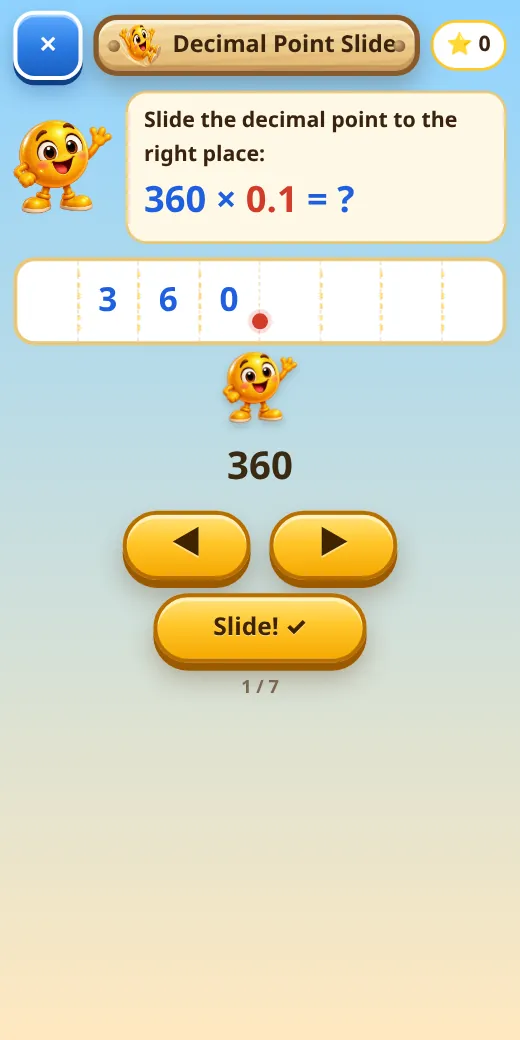
💡 I can explain patterns when multiplying by 10, 100 and 1000, and by 0.1, 0.01 and 0.001: the digits move left (bigger) or right (smaller).

8,032 × 1,000 = ?
Answer: 8,032,000
Hoda's stride is 0.72 meters. How far, in meters, will Hoda walk after taking 1,000 paces?
Answer: 720 metersNumber sentence: 0.72 × 1,000
Play this lesson ›

Lesson 5-2: Multiplying Decimals by Whole NumbersBook pages 95–96 · 10 questions in the gameضرب الكسور العشرية في أعداد صحيحة

💡 I can multiply a decimal by a whole number (model it on a number line, then write it vertically).

385 × 43 = ?
Answer: 16,555
108 × 26 = ?
Answer: 2,808
Play this lesson ›

Lesson 5-3: Multiplying Tenths by TenthsBook pages 97–98 · 7 questions in the gameضرب الأجزاء من عشرة في أجزاء من عشرة

💡 I can use models to represent multiplying decimals. Tenths × Tenths gives a product in the Hundredths.

Play this lesson ›

Lesson 5-4: Multiply decimals using the area modelBook pages 99–100 · 23 questions in the gameضرب الكسور العشرية باستخدام نموذج مساحة المستطيل

💡 I can use the area model to multiply decimals.

8 × 3 = ?
Answer: 24
Malak works for a construction company. The company had 12 pallets of cinder blocks delivered for a building project. Each pallet weighed 1.36 metric tons. How much did the cinder blocks weigh all together?
Answer: 16.32 metric tonsNumber sentence: 12 × 1.36
Play this lesson ›

Lesson 5-5: Multiplying Decimals through the Hundredths PlaceBook pages 101–102 · 12 questions in the gameضرب الكسور العشرية حتى جزء من مائة

💡 I can use the standard algorithm to multiply decimals through the Hundredths place, and use estimation to check the reasonableness of my answers.

5.8 × 7.4 = ? (4,292)
Answer: 42.92
32.4 × 5.3 = ? (17,172)
Answer: 171.72
Play this lesson ›

Lesson 5-6: Multiplying Decimals through the Thousandths PlaceBook pages 103–104 · 6 questions in the gameضرب الكسور العشرية حتى جزء من الألف

💡 I can use the standard algorithm to multiply decimals through the Thousandths place.

Play this lesson ›

Lesson 5-7: Decimals and the Metric SystemBook pages 105–107 · 23 questions in the gameالكسور العشرية والنظام المتري

💡 I can explain relationships between the metric system and decimals, and use decimals to represent equivalent measurements.

10,870 g = ? kg (1,087 / 108.7 / 10.87 / 1.087)
Answer: 10.87
3,465 mL = ? L (0.3465 / 3.465 / 34.65 / 346.5)
Answer: 3.465
Play this lesson ›

Lesson 5-8: Measurement, Decimals, and Powers of TenBook pages 108–109 · 29 questions in the gameالقياس والكسور العشرية وقوى العدد 10

💡 I can relate converting measurements in the metric system to multiplying by powers of ten.

425 × 10 = ?
Answer: 4,250
3.7 × 100 = ?
Answer: 370
Play this lesson ›

Lesson 5-9: Solving Multistep Story ProblemsBook pages 110–111 · 8 questions in the gameحل مسائل كلامية متعددة الخطوات

💡 I can solve multistep story problems involving addition, subtraction, and multiplication of decimals. Change all measurements to the same unit first.

Dalia made a liter of sugar cane juice. She drank 320 milliliters. Her father drank 0.25 liters. How much sugar cane juice is remaining?
Answer: 0.43 litersNumber sentence: 1 - 0.32 - 0.25 = 0.43
Play this lesson ›

Lesson 5-10: Dividing by Powers of TenBook pages 112–113 · 34 questions in the gameالقسمة على قوى العدد 10

💡 I can explain patterns I notice when dividing by powers of 10. Look for patterns to predict the placement of the decimal point.

2,500 ÷ 100 = ?
Answer: 25
2,500 ÷ 10 = ?
Answer: 250
Play this lesson ›

Lesson 5-11: Patterns and Relationships in Powers of TenBook pages 114–115 · 26 questions in the gameالأنماط والعلاقات في قوى العدد 10

💡 I can make connections between multiplying and dividing by powers of ten: × 0.1 is the same as ÷ 10, × 0.01 is the same as ÷ 100.

Group 1: 510.05 × 0.001 = ?
Answer: 0.51005
Group 1: 510.05 × 0.01 = ?
Answer: 5.1005
Play this lesson ›

Lesson 5-12: Dividing Decimals by Whole NumbersBook pages 116–117 · 9 questions in the gameقسمة كسور عشرية على أعداد صحيحة

💡 I can use the standard algorithm to divide decimals through the Thousandths place. Put the decimal point in the quotient right above the decimal point in the dividend.

An electrician has a wire of 150 m. He wants to divide it into 40 parts of equal length, such that the length of each part is a whole number. What is the length of one part? How many meters will be left?
Answer: 3 R 30Number sentence: 150 ÷ 40
Play this lesson ›

Lesson 5-13: Dividing Decimals by DecimalsBook pages 118–119 · 26 questions in the gameقسمة كسور عشرية على كسور عشرية

💡 I can use the standard algorithm to divide decimals through the Thousandths place. Make it a whole number: multiply the divisor and the dividend by the same power of 10.

15 ÷ ? = 5
Answer: 3
150 ÷ ? = 5
Answer: 30
Play this lesson ›

Unit 6: Numerical Expressions and Patterns التعبيرات العددية والأنماط

Lesson 6-1: Ordering of Mathematical OperationsBook pages 121–122 · 16 questions in the gameترتيب إجراء العمليات الحسابية

💡 I can use the order of operations to evaluate expressions with whole numbers and decimals. Basic order: 1. Multiply or divide from left to right. 2. Add or subtract from left to right.

45.9 − ? = 32.57
Answer: 13.33
? ÷ 9.2 = 4.8
Answer: 44.16
Play this lesson ›

Lesson 6-2: Numerical Expressions with ParenthesesBook pages 123–125 · 5 questions in the gameتعبيرات عددية تتضمن أقواسًا

💡 I can identify how grouping symbols affect the order of operations, and evaluate an expression with grouping symbols: work inside the parentheses first (× ÷ then + −, left to right), then outside.

45.84 + 13.05 ÷ 5 + 20.32 − 1.14 × 2.1 = ?
Answer: 66.376
(45.84 + 13.05) ÷ 5 + 20.32 − 1.14 × 2.1 = ?
Answer: 29.704
Play this lesson ›

Lesson 6-3: Writing Expressions to Represent ScenariosBook pages 126–127 · 16 questions in the gameكتابة تعبير عددي لتمثيل موقف ما

💡 I can write an expression to represent a written scenario. Use parentheses for the part that must be done first.

1.3 + 3.45 × 8 − 2.02 = ?
Answer: 26.88
Subtract 3.1 from 4.62. Then, multiply the result by 2.
Answer: 3.04Number sentence: (4.62 - 3.1) × 2
Play this lesson ›

Lesson 6-4: Identifying Numerical PatternsBook pages 128–131 · 18 questions in the gameتحديد الأنماط العددية

💡 I can identify a numerical pattern, explain the rule for it, and use letters (a variable like n) to represent unknown quantities in the rule.

5, 10, 20, 40, 80 . . . — Pattern? (Y / N) (Yes / No)
Answer: Yes
3, 6, 9, 15, 21, 28 . . . — Pattern? (Y / N) (Yes / No)
Answer: No
Play this lesson ›

Azzouz's Workshop: understand it before being asked 🛠️

The child doesn't need to have read the book: every lesson starts in Azzouz's Workshop before its games.

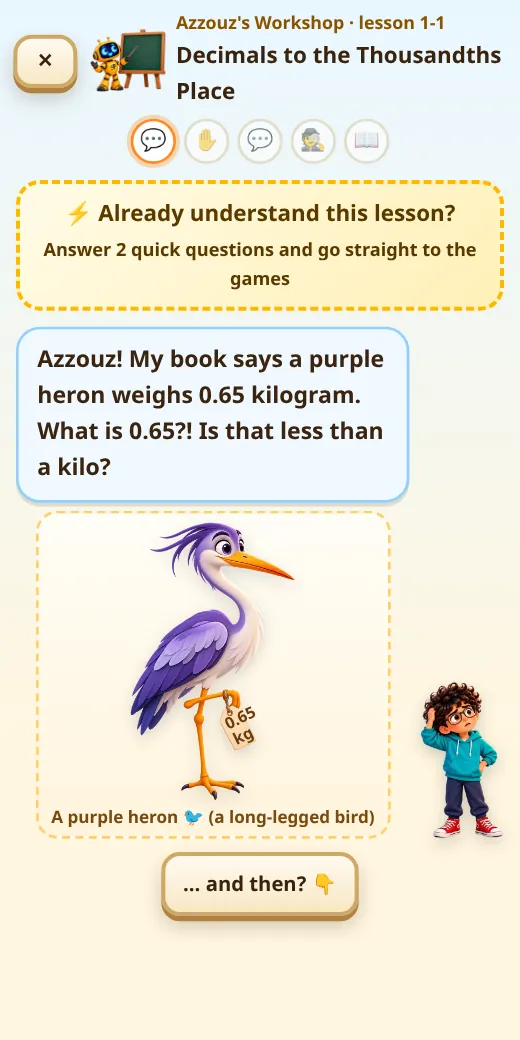
💬 Azzouz explainsAnwar asks the question any child would ask, and Azzouz answers with a small example with real numbers.
👀 Watch, then ✋ your turnAzzouz solves it step by step, then the child does the same steps by hand, one at a time.
🕵️ Fix Azzouz's mistakeThe teacher marked a mistake in Azzouz's notebook: the child finds it (the classic mistake of that lesson).
📖 A book questionThen one question from the book itself, and the games open.

Already understand the lesson from school? «⚡ Already understand this lesson?» asks two quick questions; both right the first time and the games open straight away. On any question, «🤔 I don't get it» takes the child back to the workshop. And when a sum gets long (adding, subtracting or multiplying, decimals too), «📝 Azzouz's paper» opens squared paper to work column by column, with the decimal point in its place.

How does it play? 🎲

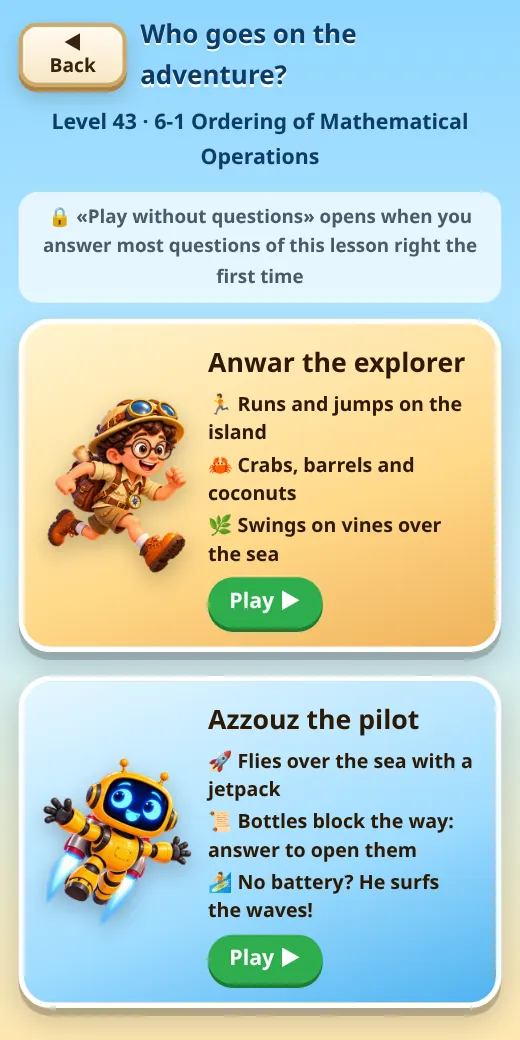
The treasure map is torn into 6 pieces and each island (a unit of the book) hides one: the child learns its lessons in the workshop and plays the book's own questions as the game they pick: the adventure (Anwar the explorer on the island or Azzouz the pilot in the sky), bowling, snakes & ladders, the Thousand Grid, Rounding Hill, the Factor Tree, Multiple Frogs, the Equation Builder, Winner Takes All, the Decimal Point Slide, the Bracket Puzzle and the Rule Machine, with the pirate's challenge at the end of each island. With friends: bowling, snakes & ladders and Maths chess by code, plus the Friends challenge. And «👪 For parents» shows progress, the lessons that need help and how to explain them, and a switch to open all lessons.
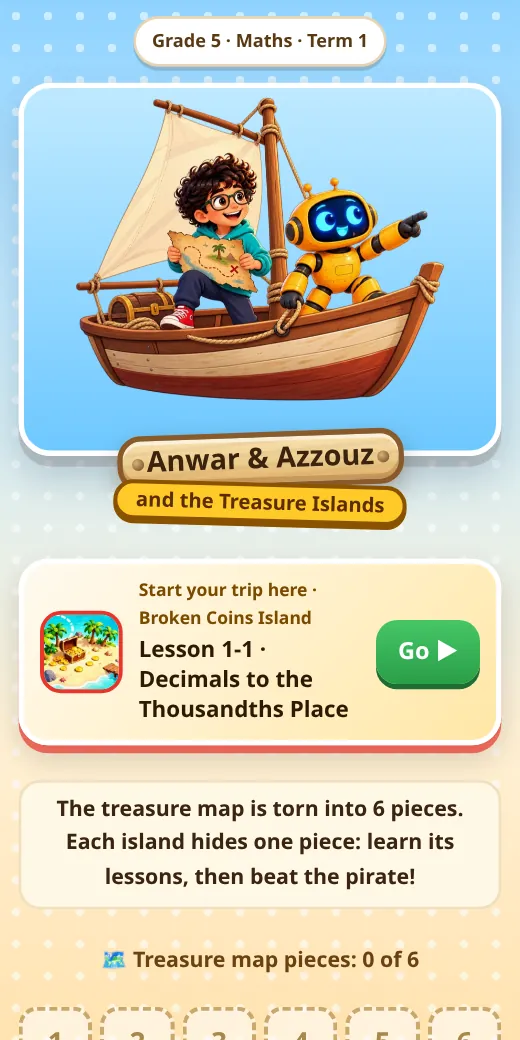
The Treasure Islands — Grade 5 Math game
The Treasure Islands6 islands = the 6 units
Azzouz's Workshop — Grade 5 Math game
Azzouz's WorkshopLearn it before being asked
The adventure — Grade 5 Math game
The adventureAnwar the explorer or Azzouz the pilot
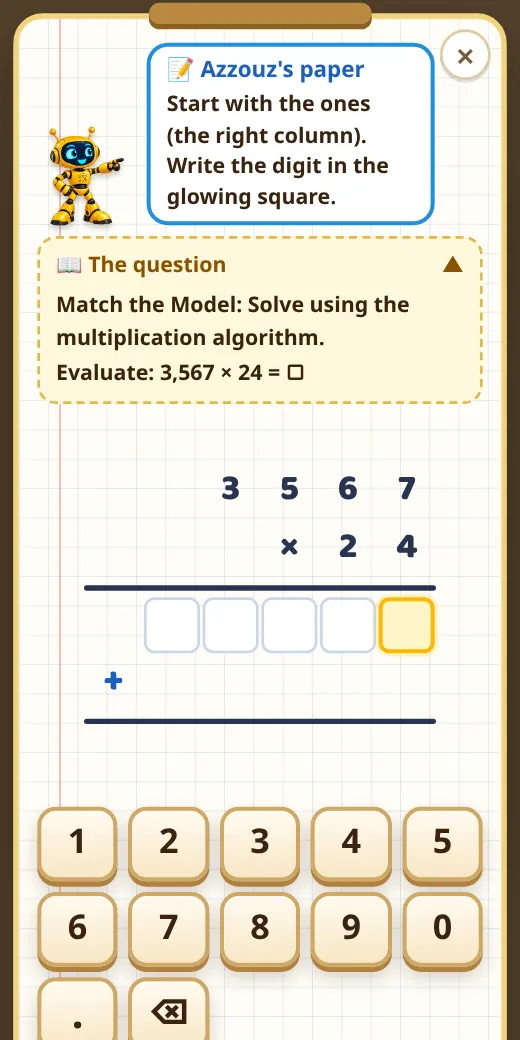
Azzouz's paper pad 📝 — Grade 5 Math game
Azzouz's paper pad 📝For long sums, decimals too
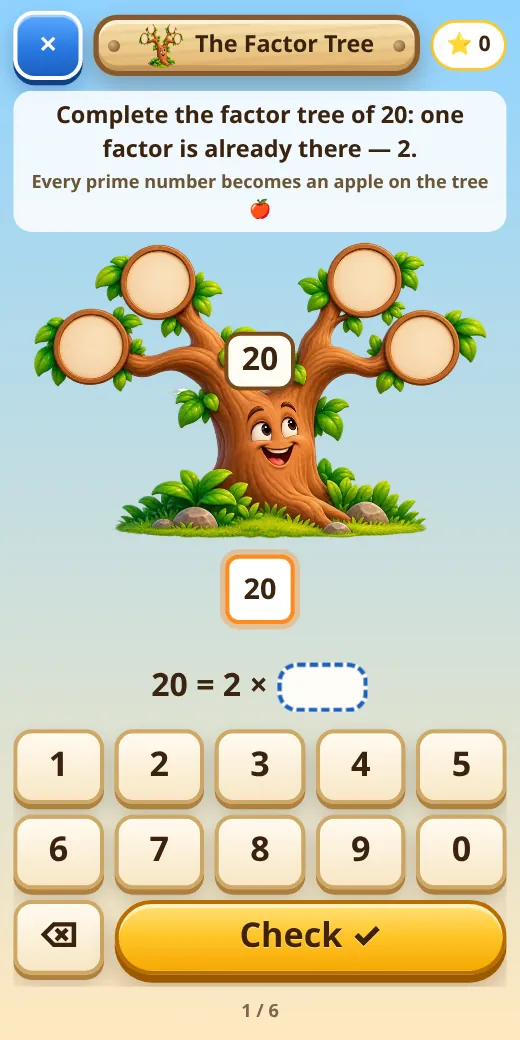
The Factor Tree — Grade 5 Math game
The Factor TreePrime factorization
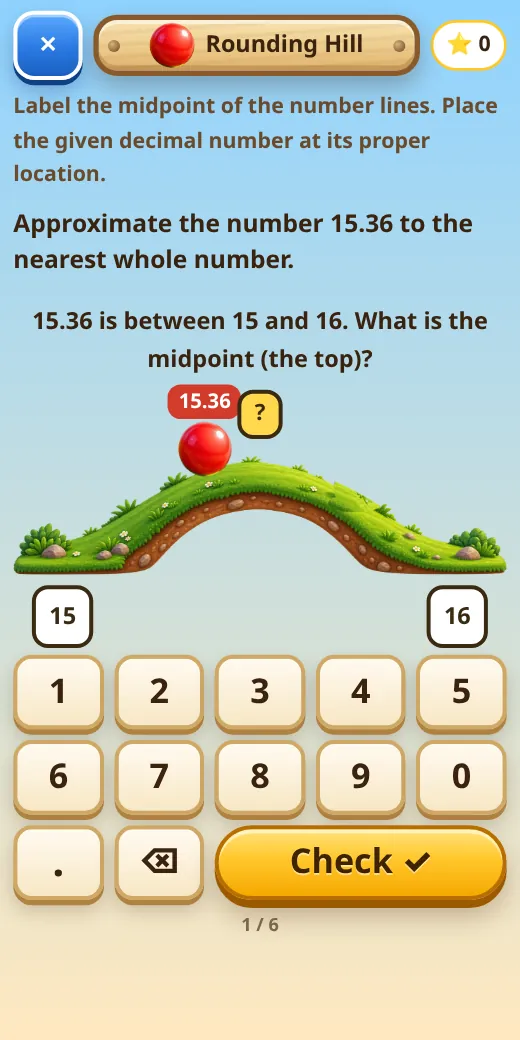
Rounding Hill — Grade 5 Math game
Rounding HillWhich way does the ball roll?
Decimal Point Slide — Grade 5 Math game
Decimal Point SlideMultiply and divide by 10, 100, 1,000
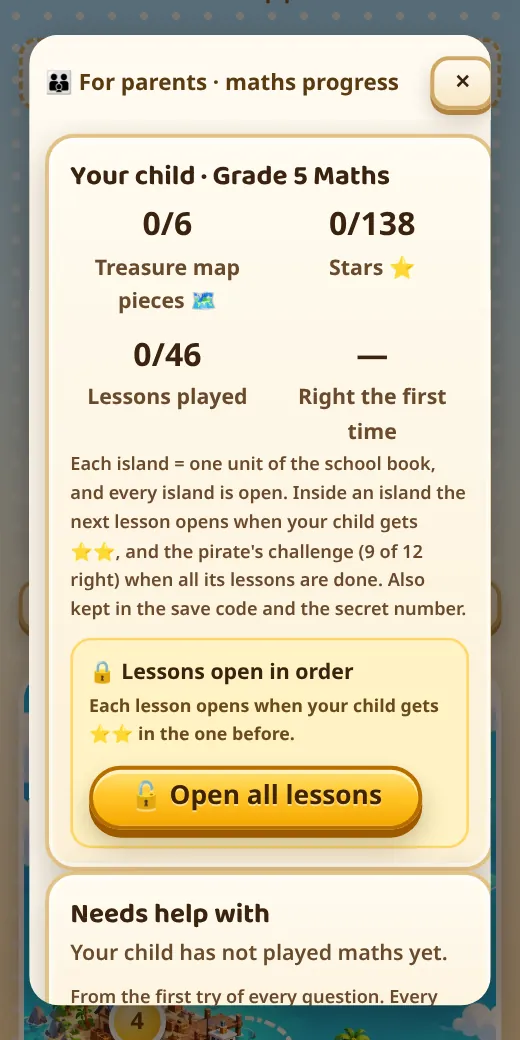
For parents 👪 — Grade 5 Math game
For parents 👪Progress and the lessons that need help

Questions from parents 💬

Is it free?

Yes. Completely free, no sign-up, and no ads inside the game.

Is it based on the school book?

Yes. Every question comes from the Egyptian Ministry of Education Grade 5 Math book, Term 1, and every lesson shows its pages in the book.

Is there an English (Languages schools) version?

Yes. The child picks the book used at school: 📕 Arabic or 📘 English. Each one uses its own book's words and numbers, and you can switch any time.

What is Azzouz's Workshop?

Before a lesson's games, Azzouz explains the idea with a small example, shows the steps, and then the child does them by hand, fixes a mistake in Azzouz's notebook and answers a question from the book. A child who already understands can tap «⚡ Already understand this lesson?»: two right answers the first time and the games open.

Which games are there?

The adventure (Anwar the explorer on the island or Azzouz the pilot in the sky), bowling, snakes & ladders, the Thousand Grid, Rounding Hill, the Factor Tree, Multiple Frogs, the Equation Builder, Winner Takes All, the Decimal Point Slide, the Bracket Puzzle and the Rule Machine. With friends: bowling, snakes & ladders and Maths chess by code, plus the Friends challenge.

What is Azzouz's paper pad?

When a sum needs pen and paper (long addition, subtraction, multiplication or division, and adding, subtracting or multiplying decimals), Azzouz floats on the screen. One tap opens squared paper with the question on it; the child works column by column and the decimal point goes in its place. It is a helper only: it never gives away the answer.

Can parents follow progress?

Yes. «👪 For parents» on the treasure map shows stars, map pieces and lessons played, the lessons the child needs help with and how to explain them, and a switch that opens all lessons (lessons otherwise open in order). It follows the child's book: Arabic or English.

Does it have other subjects?

Yes. The same game has Grade 5 Arabic, Social Studies and Science, and the child can switch subjects any time.

Does it work on a phone?

Yes, on any phone, tablet or computer. You can add it to the home screen like an app, and it works offline after the first visit.