 Anwar & Azzouz


Lesson 1-1: Decimals to the Thousandths PlaceBook pages 3–6 · 5 questions in the gameالكسور العشرية حتى جزء من الألف
💡 I can read and write decimal numbers to the Thousandths place. Right of the point: Tenths, Hundredths, Thousandths.
Free games for the whole Grade 5 Math book (Term 1, Egyptian curriculum), in English or Arabic: all 6 units, lesson by lesson, with the book's own questions. Every island is a unit of the book, and before every lesson Azzouz's Workshop explains it with a small worked example, then the child does it step by step. Azzouz's paper pad helps with long sums, decimals included.
Every lesson of the English book, in order: the lesson’s idea in the book’s words and examples of the game’s questions (tap a question to see its answer). The game has the Arabic book too.
💡 I can read and write decimal numbers to the Thousandths place. Right of the point: Tenths, Hundredths, Thousandths.
💡 I can explain how a digit changes value as it moves to the left or right in a decimal or whole number (× 10 → one place left, ÷ 10 → one place right).
💡 I can compose and decompose decimals in multiple ways.
💡 I can compare decimals to the Thousandths place.
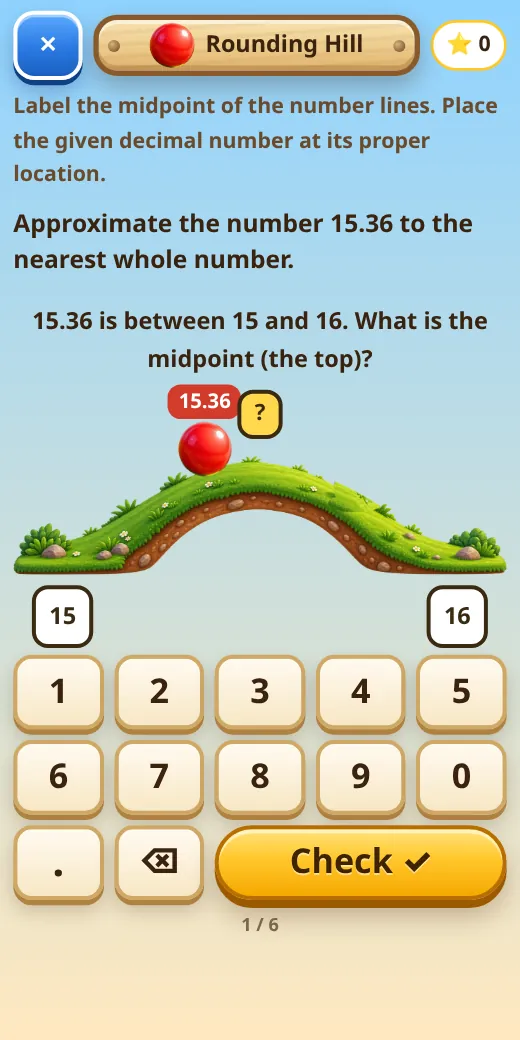
💡 I can round decimals to the nearest Tenth, Hundredth, or Thousandth (midpoint or Rounding Rule strategy).
💡 I can estimate sums of decimal numbers. Estimation Strategies: Front-End Estimation (Round to Ones), Benchmark Decimals (Round to Tenths), Separate Wholes and Parts (Round to Hundredths).
💡 I can model decimal addition: shade each addend in a different color on the decimal grid, record them in the place value chart, then add.
💡 I can model decimal subtraction. The shaded minuend is a decimal number; the x's represent the subtrahend, the number that is subtracted from the minuend.
💡 I can estimate differences of decimal numbers: round each number (to ones, tenths or hundredths), subtract the easy numbers, then calculate the actual difference.
💡 I can apply strategies to subtract decimals to the Thousandths place. I can check the reasonableness of my answers.
💡 I can add and subtract decimal numbers to the Thousandths place to solve story problems: read and think about what the question is asking, write an equation, then solve.
💡 I can explain the difference between expressions and equations. I can use letters or symbols to represent unknowns in expressions and equations.
💡 I can apply the relationship between addition and subtraction to find the value of the unknown in an equation.
💡 I can write story problems involving addition and subtraction of decimal numbers. I can solve equations involving decimal numbers to the thousandths place.
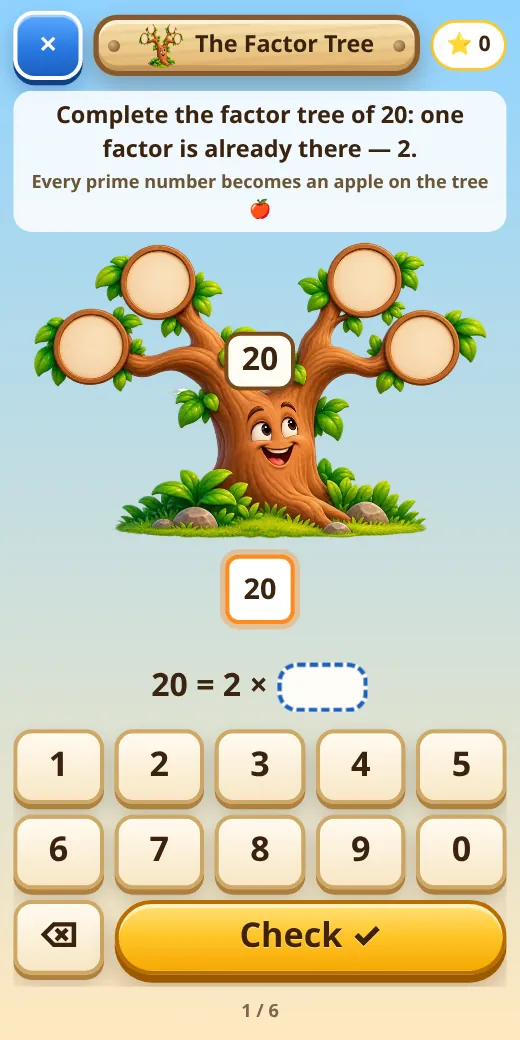
💡 I can use a factor tree to identify the prime factors of a given number. Decompose the composite factors until only prime numbers remain.
💡 I can use factor trees to identify common factors and the greatest common factor of two whole numbers.
💡 I can explain the meaning of multiples. I can identify common multiples of two whole numbers up to 12.
💡 I can explain the meaning of least common multiple. I can identify the least common multiple of two whole numbers up to 12.
💡 I can explain the difference between factors and multiples. I can identify the greatest common factor and least common multiple of two given numbers.
💡 I can multiply using the area model: break each number by place value, multiply each part, then add.
💡 I can explain the relationship between the area model and the Distributive Property: all numbers inside parentheses are multiplied by the number outside the parentheses.
💡 I can multiply by a 2-digit number using the standard algorithm: start with the ones place, remember place value, line up the products by place value before you add them.
💡 I can multiply 4-digit numbers by 2-digit numbers using the standard algorithm, and use estimation to check the reasonableness of my answers.
💡 I can solve multistep story problems involving multiplication.
💡 I can use the area model to solve division problems: subtract parts of the dividend (divisor × 100, × 10, …), then add the partial quotients.
💡 I can use estimation to check the reasonableness of my answers: estimate the quotient using compatible numbers.
💡 I can use the standard algorithm to divide by a 2-digit divisor.
💡 I can use the standard algorithm to divide by a 2-digit divisor, and use multiplication (and addition of the remainder) to check answers to division problems.
💡 I can solve multistep story problems involving whole numbers and the four operations.
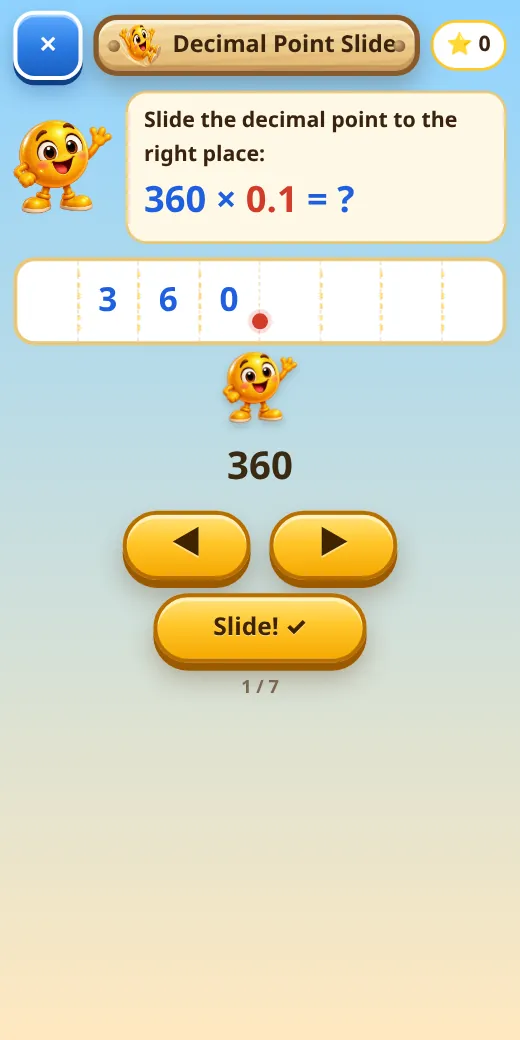
💡 I can explain patterns when multiplying by 10, 100 and 1000, and by 0.1, 0.01 and 0.001: the digits move left (bigger) or right (smaller).
💡 I can multiply a decimal by a whole number (model it on a number line, then write it vertically).
💡 I can use models to represent multiplying decimals. Tenths × Tenths gives a product in the Hundredths.
💡 I can use the area model to multiply decimals.
💡 I can use the standard algorithm to multiply decimals through the Hundredths place, and use estimation to check the reasonableness of my answers.
💡 I can use the standard algorithm to multiply decimals through the Thousandths place.
💡 I can explain relationships between the metric system and decimals, and use decimals to represent equivalent measurements.
💡 I can relate converting measurements in the metric system to multiplying by powers of ten.
💡 I can solve multistep story problems involving addition, subtraction, and multiplication of decimals. Change all measurements to the same unit first.
💡 I can explain patterns I notice when dividing by powers of 10. Look for patterns to predict the placement of the decimal point.
💡 I can make connections between multiplying and dividing by powers of ten: × 0.1 is the same as ÷ 10, × 0.01 is the same as ÷ 100.
💡 I can use the standard algorithm to divide decimals through the Thousandths place. Put the decimal point in the quotient right above the decimal point in the dividend.
💡 I can use the standard algorithm to divide decimals through the Thousandths place. Make it a whole number: multiply the divisor and the dividend by the same power of 10.
💡 I can use the order of operations to evaluate expressions with whole numbers and decimals. Basic order: 1. Multiply or divide from left to right. 2. Add or subtract from left to right.
💡 I can identify how grouping symbols affect the order of operations, and evaluate an expression with grouping symbols: work inside the parentheses first (× ÷ then + −, left to right), then outside.
💡 I can write an expression to represent a written scenario. Use parentheses for the part that must be done first.
💡 I can identify a numerical pattern, explain the rule for it, and use letters (a variable like n) to represent unknown quantities in the rule.
The child doesn't need to have read the book: every lesson starts in Azzouz's Workshop before its games.
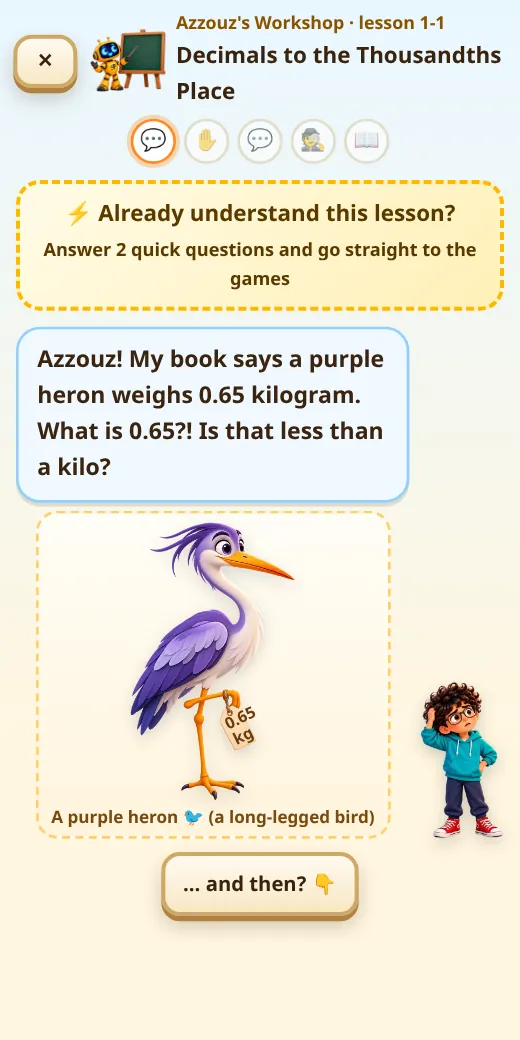
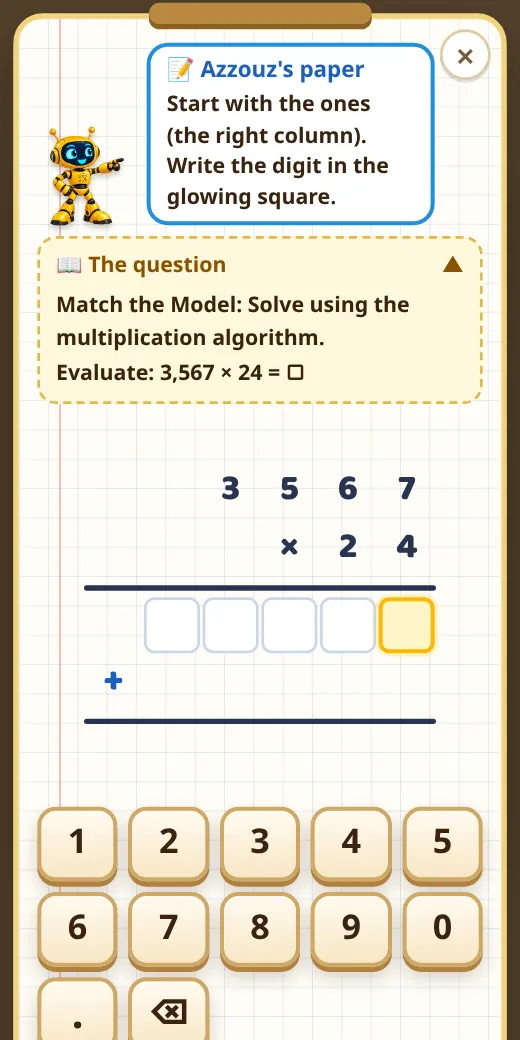
Already understand the lesson from school? «⚡ Already understand this lesson?» asks two quick questions; both right the first time and the games open straight away. On any question, «🤔 I don't get it» takes the child back to the workshop. And when a sum gets long (adding, subtracting or multiplying, decimals too), «📝 Azzouz's paper» opens squared paper to work column by column, with the decimal point in its place.
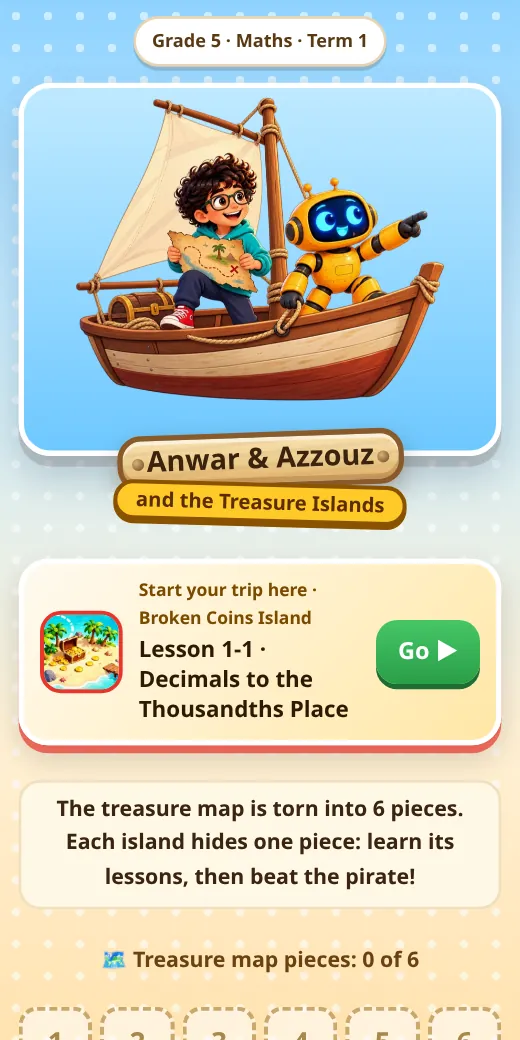
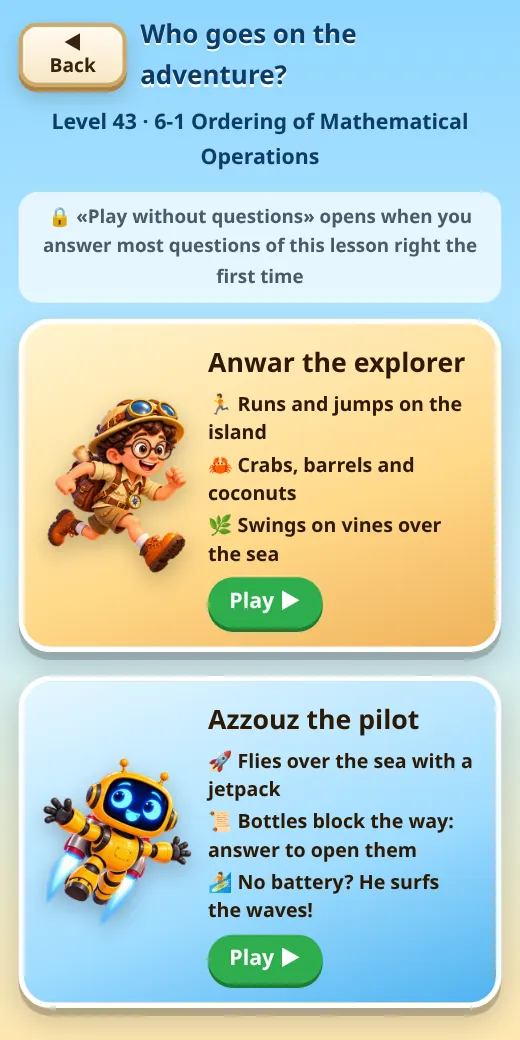
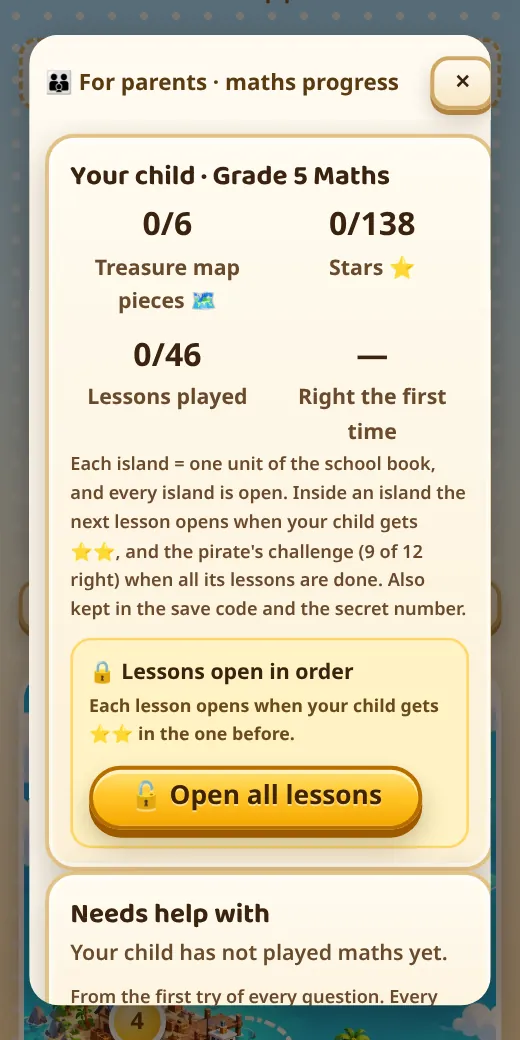
The treasure map is torn into 6 pieces and each island (a unit of the book) hides one: the child learns its lessons in the workshop and plays the book's own questions as the game they pick: the adventure (Anwar the explorer on the island or Azzouz the pilot in the sky), bowling, snakes & ladders, the Thousand Grid, Rounding Hill, the Factor Tree, Multiple Frogs, the Equation Builder, Winner Takes All, the Decimal Point Slide, the Bracket Puzzle and the Rule Machine, with the pirate's challenge at the end of each island. With friends: bowling, snakes & ladders and Maths chess by code, plus the Friends challenge. And «👪 For parents» shows progress, the lessons that need help and how to explain them, and a switch to open all lessons.
Yes. Completely free, no sign-up, and no ads inside the game.
Yes. Every question comes from the Egyptian Ministry of Education Grade 5 Math book, Term 1, and every lesson shows its pages in the book.
Yes. The child picks the book used at school: 📕 Arabic or 📘 English. Each one uses its own book's words and numbers, and you can switch any time.
Before a lesson's games, Azzouz explains the idea with a small example, shows the steps, and then the child does them by hand, fixes a mistake in Azzouz's notebook and answers a question from the book. A child who already understands can tap «⚡ Already understand this lesson?»: two right answers the first time and the games open.
The adventure (Anwar the explorer on the island or Azzouz the pilot in the sky), bowling, snakes & ladders, the Thousand Grid, Rounding Hill, the Factor Tree, Multiple Frogs, the Equation Builder, Winner Takes All, the Decimal Point Slide, the Bracket Puzzle and the Rule Machine. With friends: bowling, snakes & ladders and Maths chess by code, plus the Friends challenge.
When a sum needs pen and paper (long addition, subtraction, multiplication or division, and adding, subtracting or multiplying decimals), Azzouz floats on the screen. One tap opens squared paper with the question on it; the child works column by column and the decimal point goes in its place. It is a helper only: it never gives away the answer.
Yes. «👪 For parents» on the treasure map shows stars, map pieces and lessons played, the lessons the child needs help with and how to explain them, and a switch that opens all lessons (lessons otherwise open in order). It follows the child's book: Arabic or English.
Yes. The same game has Grade 5 Arabic, Social Studies and Science, and the child can switch subjects any time.
Yes, on any phone, tablet or computer. You can add it to the home screen like an app, and it works offline after the first visit.