
🔬 Grade 4 Science · Term 1 · Egyptian curriculum

Grade 4 Science games, Term 1: the Anwar & Azzouz Lab

Free games and hands-on experiments for the whole Grade 4 Science book (Term 1, Egyptian curriculum), in English or Arabic: all 8 chapters, lesson by lesson, with the book's own questions and a badge for every finished chapter.

26 lessons8 chapters100+ questions📕 Arabic + 📘 EnglishFree 💙📴 Works offline
🔤 And Grade 4 English too ›

The book, lesson by lesson 📚

Every lesson of the English book, in order: its first «Learn» sentence and examples of the book questions in the game (tap a question to see its answer). The game has the Arabic book too.

Chapter 1: Nature in Our Surroundings الطبيعة من حولنا

Lesson 1-1: Let's Find Living OrganismsBook pages 6–7لنبحث عن الكائنات الحية

💡 Living organisms, such as humans, animals, and plants, differ from non-living things, such as rocks, water, and air. They eat, breathe and grow.

Play this lesson ›

Lesson 1-2: How to Observe?Book pages 8–11 · 15 questions in the gameكيف نلاحظ؟

💡 When you look closely at living organisms, pay attention to shape, color, and size.

Grasshoppers are often in the ____.
Answer: grass
Ants are often in ____ places like under stones.
Answer: damp
Play this lesson ›

Lesson 1-3: Colors and Shapes of Living OrganismsBook pages 12–15ألوان وأشكال الكائنات الحية

💡 You can group living organisms by looking at their color and shape.

Play this lesson ›

Lesson 1-4: Different Places, Different Living OrganismsBook pages 16–19 · 7 questions in the gameأماكن مختلفة.. كائنات حية مختلفة

💡 The place where a living organism lives is called its habitat.

What do you call the place where a living organism lives?
Answer: habitat
What do you think would happen if you took a frog living in the Nile River to the desert? Answer with your reason.
Answer: It could not live there, because the desert has very little water and dry soil, and the frog is not adapted to it.
Play this lesson ›

Lesson 1-5: Desert Living OrganismsBook pages 20–23 · 4 questions in the gameالكائنات الحية الصحراوية

💡 In the deserts of Egypt, living organisms have special body shapes and ways of living that help to adapt with the harsh environment.

The Jerboa uses its long ____ to jump and move quickly avoiding the hot ground.
Answer: back legs
Play this lesson ›

Chapter 2: How Insects Grow كيف تنمو الحشرات؟

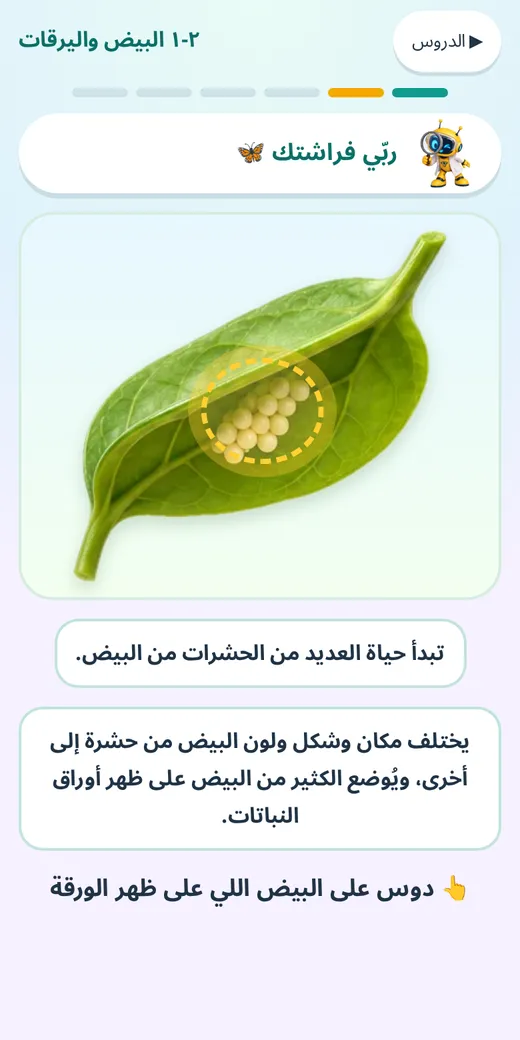
Lesson 2-1: Eggs and LarvaeBook pages 26–27 · 5 questions in the gameالبيض واليرقات

💡 Many insects begins from eggs.

Butterflies are born from (____).
Answer: Eggs
The baby that just came out of the egg is called a (____).
Answer: Larva
Play this lesson ›

Lesson 2-2: Pupae and adult insectsBook pages 28–31 · 4 questions in the gameالشرنقة والحشرات البالغة

💡 Butterflies grow in this order: Egg → Larva → Pupa → adult insect. Dung beetles and bees are also in this group.

Butterfly growth: Egg → Larva → (____) → Adult insect
Answer: Pupa
Play this lesson ›

Lesson 2-3: Body Structure of adult insectsBook pages 32–35 · 6 questions in the gameتركيب جسم الحشرات البالغة

💡 The body of an adult butterfly: It is made of 3 parts: Head, Thorax, and Abdomen.

Adult insects have wings, unlike larvae. How many wings do they have?
Answer: 4
What do we call the long, rod-like parts on an insect's head?
Answer: Antennae
Play this lesson ›

Chapter 3: How Plants Grow كيف تنمو النباتات؟

Lesson 3-1: Sowing SeedsBook pages 36–37 · 4 questions in the gameزراعة البذور

💡 Most plants start growing from seeds.

What is the first important thing to do after you cover the seeds with soil?
Answer: Give it plenty of water.
Play this lesson ›

Lesson 3-2: After SproutingBook pages 38–41 · 4 questions in the gameبعد الإنبات

💡 After you sow seeds and wait for a while, sprouts will come out.

When measuring plant height, where should you measure from and to?
Answer: From the ground to the base of the top leaf.
Play this lesson ›

Lesson 3-3: Flowers and FruitsBook pages 42–45 · 4 questions in the gameالأزهار والثمار

💡 When plants grow big, they make buds, bloom flowers, and then make fruits.

Play this lesson ›

Lesson 3-4: The Plant BodyBook pages 46–49 · 8 questions in the gameأجزاء النبات

💡 A plant's body is made up of three main parts.

It has a flat shape and catches sunlight.
Answer: Leaves
It supports the body and is a pathway for water.
Answer: Stem
Play this lesson ›

Chapter 4: Properties of Light خصائص الضوء

Lesson 4-1: How Sunlight Travels?Book pages 50–51 · 5 questions in the gameكيف ينتقل ضوء الشمس؟

💡 Objects that emit their own light, such as the Sun and lamps, are called light sources.

Sunlight reflected by a mirror travels ____ forever.
Answer: straight lines
What do we call it when light hits an object and bounces back?
Answer: Reflection
Play this lesson ›

Lesson 4-2: Gathering LightBook pages 52–55 · 6 questions in the gameتجميع الضوء

💡 Using a magnifying glass, you can gather sunlight from a wide area into a single point.

Do not look directly at the ____ with a magnifying glass.
Answer: Sun
Do not look at the place where sunlight is gathered for a ____.
Answer: long time
Play this lesson ›

Lesson 4-3: Shadows and the Sun (1)Book pages 56–57 · 4 questions in the gameالظلال والشمس (١)

💡 Direction of Shadows: Shadows are made in the opposite direction of the light source (e.g. sun).

Sunlight travels ____, so when it hits an object, it is blocked, and a dark place is made behind it. This is a shadow.
Answer: straight lines
The direction of the shadow is ____ to the direction of the sun.
Answer: opposite
Play this lesson ›

Lesson 4-4: Shadows and the Sun (2)Book pages 58–61 · 4 questions in the gameالظلال والشمس (٢)

💡 The sun appears in the sky that it rises from the East then it sets in the West. When the sun moves, the direction of the shadow (which is on the opposite side from the sun) also changes.

What is the name of the tool that tells time using the change in shadow position?
Answer: Sundial
Play this lesson ›

Lesson 4-5: Sun and ShadeBook pages 62–64 · 4 questions in the gameالشمس والظل

💡 The ground in sunny places becomes warmer than the ground in shady places. This is because sunlight warms the sunny ground.

Play this lesson ›

Chapter 5: Properties of Sound خصائص الصوت

Lesson 5-1: How Sound is Produced?Book pages 68–69 · 4 questions in the gameكيف ينتج الصوت؟

💡 When an object makes a sound, it is shaking. This shaking is called vibration.

When an object makes a sound, it vibrates and this movement is called ____.
Answer: vibration
Play this lesson ›

Lesson 5-2: Volume of Sound and VibrationBook pages 70–73 · 5 questions in the gameشدة الصوت والاهتزاز

💡 When the amount of vibration changes, the volume of the sound changes.

When a loud sound is made, the vibration of an object becomes ____.
Answer: big
When a soft sound is made, the vibration of an object becomes ____.
Answer: small
Play this lesson ›

Lesson 5-3: How Sound Travels?Book pages 74–76 · 6 questions in the gameكيف ينتقل الصوت؟

💡 The vibration of sound travels not only through the air but also through solid objects like string.

A loud voice travels even when the string of the string telephone is not vibrating.
Answer: False
Even if you use a wire instead of a string, you can hear the sound if the vibration travels.
Answer: True
Play this lesson ›

Chapter 6: The Force of Wind قوة الرياح

Lesson 6-1: Wind-Powered CarsBook pages 78–79 · 6 questions in the gameالسيارات التي تعمل بقوة الرياح

💡 A force is a push or pull that can cause a stationary object to move, stop a moving object, or change the direction of its motion. The greater the force, the greater its effect on the object.

The distance the car travels is ____ when it is hit by a strong wind than when it is hit by a weak wind.
Answer: longer
Wind has the power to move things.
Answer: True
Play this lesson ›

Lesson 6-2: Sail SizeBook pages 80–83 · 4 questions in the gameحجم الشراع

💡 When the wind strength is the same, and in the same direction of the body movement, the larger surface area that catches the wind (the sail), the bigger the power it gets from the wind.

When the wind strength is the same, which car can travel the “farthest”?
Answer: A car with a large sail
Play this lesson ›

Chapter 7: The Force of Rubber قوة المطاط

Lesson 7-1: Rubber Band-Powered CarsBook pages 84–85 · 4 questions in the gameالسيارات التي تعمل بقوة المطاط

💡 A rubber band has a nature to try to return to its original shape when it is stretched. You can use the power of a stretched rubber band to make things fly or make cars run.

When does a rubber band produce power?
Answer: When the rubber band is stretched and trying to return to its original shape.
From the results of the experiment, we learned that making the power of the wind or rubber bands ____ allows us to move the car farther.
Answer: stronger
Play this lesson ›

Lesson 7-2: Power of Rubber BandsBook pages 86–89 · 4 questions in the gameقوة الأشرطة المطاطية

💡 The longer you stretch the rubber band, the stronger the power to move things becomes.

We increased the number of rubber bands to make the power to move the car stronger. When we do this, what happens to the distance the car travels?
Answer: The distance becomes longer.
Play this lesson ›

Chapter 8: Soil, Water, and Life in Egypt التربة والماء والحياة في مصر

Lesson 8-1: The Relationship Between the Ground and WaterBook pages 92–95 · 4 questions in the gameالعلاقة بين اليابسة والماء

💡 The speed at which water soaks into the ground depends on the size of the particles that make up the soil.

How does the speed of water soaking in change when the soil particles are larger?
Answer: Water leaks through quickly.
What are the properties of the fine “mud (silt)” along the Nile River in Egypt?
Answer: The particles are small, and water passes through slowly.
Play this lesson ›

Lesson 8-2: Transporting Giant Stone StatuesBook pages 96–99 · 4 questions in the gameنقل التماثيل الحجرية الضخمة

💡 To move a giant stone statue, a very large force was needed.

When moving a heavy stone statue, why do many people pull the rope?
Answer: To make a larger force than when there is only one person.
When moving a heavy object, if you make the ground slippery, what happens to the force needed?
Answer: You need less force.
Play this lesson ›

How does it play? 🎲

Every lesson: a big question, an experiment the child does on screen, the book's own «Science words», then the book's questions. A wrong answer shows the book sentence with the answer. Many lessons end with a short game: the living-things basket, the sharp photographer, Mummy Butterfly, when do we sow?, the light maze, the sun clock, who is making a sound? and the rubber slingshot. Each chapter ends with a chapter test that tells parents which lessons need review, and finishing a chapter with at least two stars in every lesson earns its badge to share.
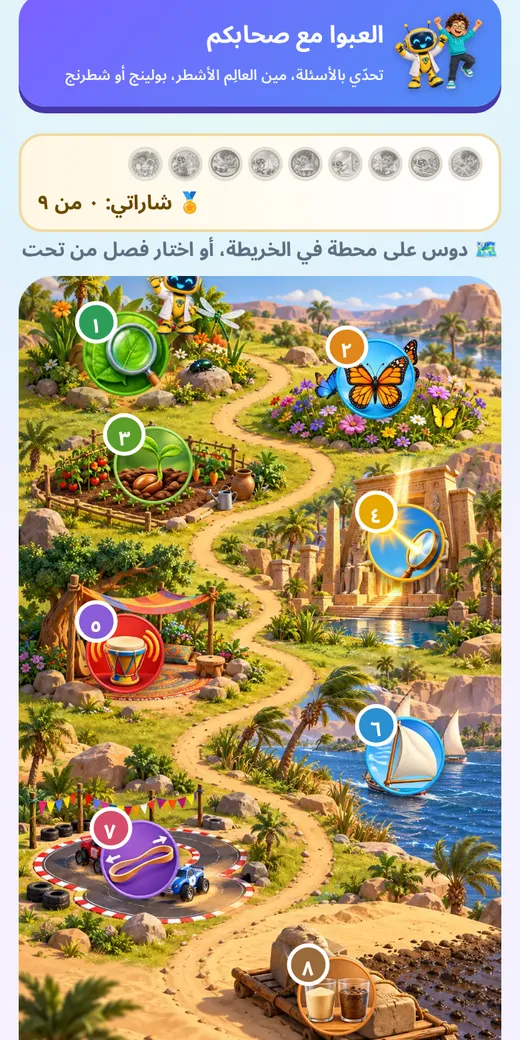
The chapters map — Grade 4 Science game
The chapters mapAll 8 chapters, in order
The experiment — Grade 4 Science game
The experimentTry it yourself, like the book
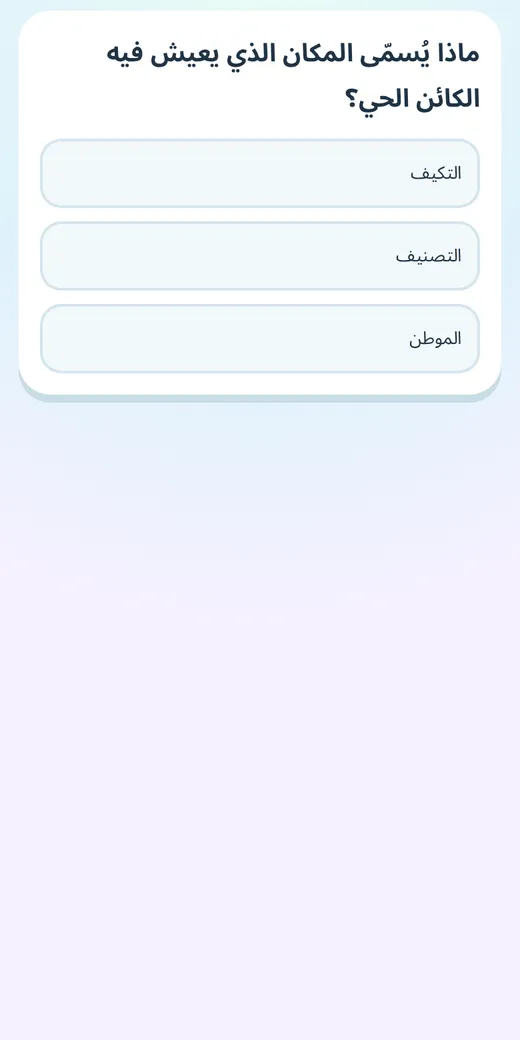
Book questions — Grade 4 Science game
Book questionsA wrong answer shows the book sentence
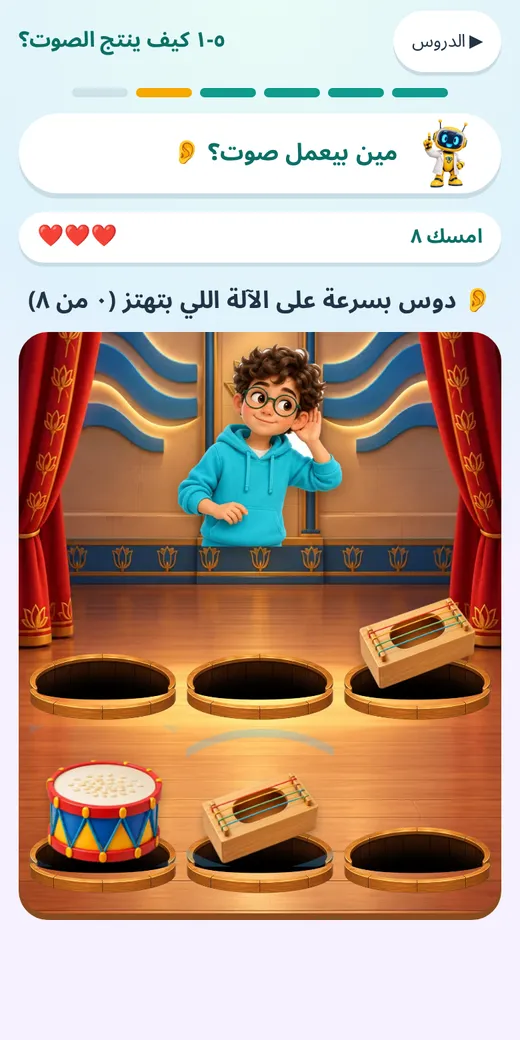
Who makes a sound? — Grade 4 Science game
Who makes a sound?Catch the instrument that vibrates
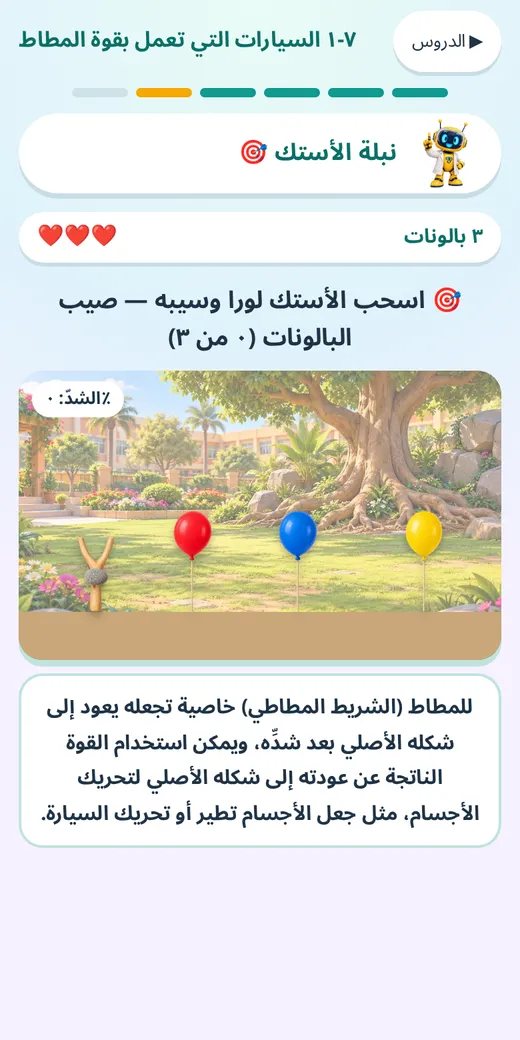
The rubber slingshot — Grade 4 Science game
The rubber slingshotStretch and pop the balloons
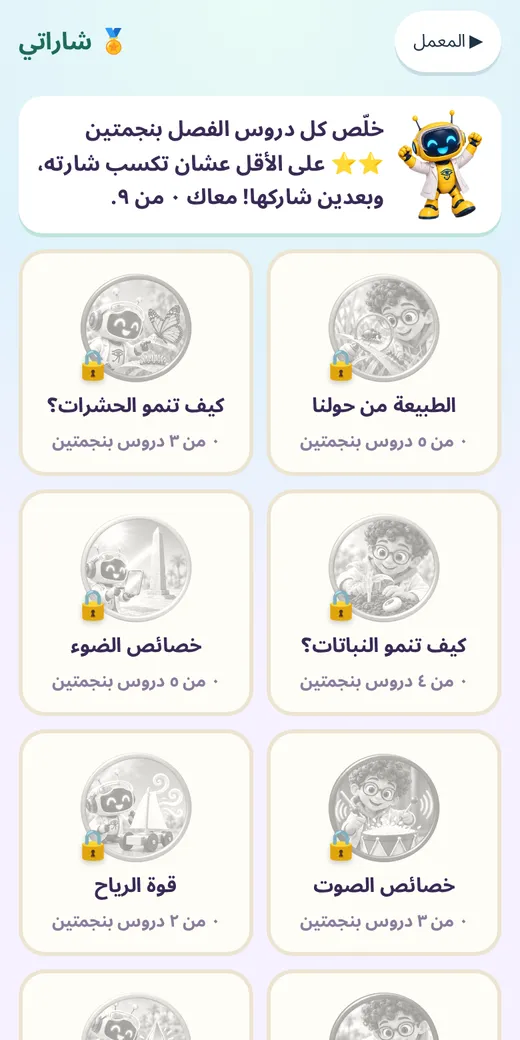
My badges 🏅 — Grade 4 Science game
My badges 🏅A badge for every finished chapter

Questions from parents 💬

Is it free?

Yes. Completely free, no sign-up, and no ads inside the game.

Is it based on the school book?

Yes. Every question and every «Science words» sentence comes from the Egyptian Ministry of Education Grade 4 Science book, Term 1, and every lesson shows its pages in the book.

Is there an English (Languages schools) version?

Yes. The child picks the book used at school: 📕 Arabic or 📘 English, and you can switch any time.

What are the experiments?

Each lesson starts with a big question, then the child tries it on screen like the book: raise a butterfly, plant a seed and watch it grow, see the obelisk’s shadow move with the sun, hit a drum and watch the rice jump, pull a rubber band and see how far the car goes.

What are the badges?

Finishing every lesson of a chapter with at least two stars earns that chapter's badge, and all 8 earn the big «Anwar & Azzouz Scientist» badge. The child can share an earned badge.

Can parents follow progress?

Yes. The «For parents» page shows each child's science lessons, stars and the questions answered wrong, and every chapter test lists the lessons to review.

Does it have other subjects?

Yes. The same game has Grade 4 Arabic, Social Studies and Math, and the child can switch subjects any time.

Does it have English too?

Yes. The same game has Grade 4 English, lesson by lesson from the Ministry book, with every word spoken and a small Arabic line for parents.

Does it work on a phone?

Yes, on any phone, tablet or computer. You can add it to the home screen like an app, and it works offline after the first visit.