🧮 Grade 3 Math · Term 1 · Egyptian curriculum

Grade 3 Math games, Term 1: the City of Blocks

Free games for the whole Grade 3 Math book (Term 1, Egyptian curriculum), in English or Arabic: all 10 chapters, lesson by lesson, with the book's own questions.

37 lessons10 chapters900+ questions📕 Arabic + 📘 EnglishFree 💙📴 Works offline
🔤 And Grade 3 English too ›

The book, lesson by lesson 📚

Every lesson of the English book, in order: the lesson’s idea in the book’s words and examples of the game’s questions (tap a question to see its answer). The game has the Arabic book too.

Chapter 1: Rules of Multiplication قواعد الضرب

Lesson 1-1: Properties of Multiplication (Part 1)Book pages 8–9 · 18 questions in the gameخواص الضرب (الجزء الأول)

💡 When you add 1 to the Multiplier, the answer gets bigger by the Multiplicand. You can switch the order of the numbers, and the answer will be the same.

2 × 5 is ? more than 2 × 4.
Answer: 2
5 × 3 is ? less than 5 × 4.
Answer: 5
Play this lesson ›

Lesson 1-2: Properties of Multiplication (Part 2)Book pages 10–11 · 10 questions in the gameخواص الضرب (الجزء الثاني)

💡 You can break up the Multiplicand to multiply, and the answer will be the same. You can break up the Multiplier to multiply, and the answer will be the same.

Play this lesson ›

Lesson 1-3: Multiplying by 10 and 0 (Part 1)Book pages 12–13 · 18 questions in the gameالضرب في 10 وفي 0 (الجزء الأول)

💡 Multiplying by 10: 10 × 1 = 10, 10 × 2 = 20, 10 × 3 = 30 … 10 × 10 = 100. Any number multiplied by 0 is 0.

10 × 3 = ?
Answer: 30
One box has 10 pencils. If you buy 4 boxes, how many pencils will you have in total?
Answer: 40 pencilsNumber sentence: 10 × 4
Play this lesson ›

Lesson 1-4: Multiplying by 10 and 0 (Part 2)Book pages 14–15 · 12 questions in the gameالضرب في 10 وفي 0 (الجزء الثاني)

💡 Score is calculated by (Points) × (Count).

Play this lesson ›

Lesson 1-5: Find the Missing NumbersBook pages 16–17 · 18 questions in the gameإيجاد العدد المجهول

💡 If you don't know the Multiplier, think about the times table for the first number. If you don't know the Multiplicand, you can use the multiplication rules.

3 × ? = 12
Answer: 4
6 × ? = 36
Answer: 6
Play this lesson ›

Review and PracticeBook pages 18–19 · 34 questions in the gameتمرين: مراجعة وتدريب

3 × 5 is ? more than 3 × 4.
Answer: 3
6 × 3 is ? less than 6 × 4.
Answer: 6
Play this lesson ›

Chapter 2: Time and Duration الوقت والمدة الزمنية

Lesson 2-1: Finding Time Before and After (Part 1)Book pages 20–21 · 8 questions in the gameإيجاد الوقت قبل وبعد (الجزء الأول)

💡 When you find the time for “minutes before” or “minutes after,” use a clock face or a number line to help you think.

Play this lesson ›

Lesson 2-2: Finding Time Before and After (Part 2)Book pages 22–25 · 13 questions in the gameإيجاد الوقت قبل وبعد (الجزء الثاني)

💡 1 hour = 60 minutes. To find the time between two moments, first find the time to the next hour.

1 hour 20 minutes = ? minutes
Answer: 80
The time from 4:50 PM to 5:20 PM = ? minutes
Answer: 30
Play this lesson ›

Lesson 2-3: Shorter Time UnitsBook pages 26–29 · 22 questions in the gameوحدات زمنية أقصر

💡 A second is a unit of time shorter than a minute. 1 minute = 60 seconds

1 minute = ? seconds
Answer: 60
1 minute 40 seconds = ? seconds
Answer: 100
Play this lesson ›

Review and PracticeBook pages 30–31 · 20 questions in the gameتمرين: مراجعة وتدريب

1 hour 35 minutes = ? minutes
Answer: 95
1 minute = ? seconds
Answer: 60
Play this lesson ›

Chapter 3: Division القسمة

Lesson 3-1: DivisionBook pages 32–33 · 10 questions in the gameالقسمة

15 ÷ 5 = ?
Answer: 3
Play this lesson ›

Lesson 3-2: Sharing and DivisionBook pages 34–35 · 8 questions in the gameالتوزيع والقسمة

If you share 12 strawberries equally among 3 people, how many strawberries will each person get?
Answer: 4 strawberriesNumber sentence: 12 ÷ 3 = 4
Play this lesson ›

Lesson 3-3: Scenarios for DivisionBook pages 36–37 · 6 questions in the gameحالات استخدام القسمة

Play this lesson ›

Lesson 3-4: Division to CompareBook pages 40–41 · 8 questions in the gameالقسمة للمقارنة

Gamal is 8 years old, and his grandmother is 64 years old. How many times as old as Gamal is his grandmother?
Answer: 8 timesNumber sentence: 64 ÷ 8 = 8
Play this lesson ›

Review and PracticeBook pages 42–43 · 10 questions in the gameتمرين: مراجعة وتدريب

Play this lesson ›

Chapter 4: Addition and Subtraction الجمع والطرح

Lesson 4-1: Adding 3- and 4-Digit NumbersBook pages 44–45 · 20 questions in the gameجمع الأعداد المكونة من 3 و4 أرقام

💡 Start from the ones place, and add the digits in the same place value. If the sum is 10 or more, carry over 1 to the next place value.

Play this lesson ›

Lesson 4-2: Subtracting 3- and 4-Digit Numbers (Part 1)Book pages 46–47 · 23 questions in the gameطرح الأعداد المكونة من 3 و4 أرقام (الجزء الأول)

💡 Start from the ones place, and subtract the digits in the same place value. If you can't subtract, TAKE 1 from the next place value.

Play this lesson ›

Lesson 4-3: Subtracting 3- and 4-Digit Numbers (Part 2)Book pages 48–49 · 24 questions in the gameطرح الأعداد المكونة من 3 و4 أرقام (الجزء الثاني)

💡 In vertical subtraction, if you can't subtract the digits, take 1 from the next place value. If the next place value is 0, you must take from the next place after that.

Play this lesson ›

Lesson 4-4: Addition and SubtractionBook pages 50–51 · 9 questions in the gameمسائل كلامية على الجمع والطرح

💡 Use addition for problems that ask for the “total,” “increase,” or “cost.” Use subtraction for problems that ask for “how many more,” the “difference,” or the “change.”

There are 475 books. If the number increases by 125 books, how many books will there be? Write a mathematical sentence and the answer.
Answer: 600 booksNumber sentence: 475 + 125
Play this lesson ›

Review and PracticeBook pages 52–53 · 30 questions in the gameتمرين: مراجعة وتدريب

There are 485 books. If the number increases by 235 books, how many books will there be? Write the mathematical sentence and the answer.
Answer: 720 booksNumber sentence: 485 + 235
Play this lesson ›

Chapter 5: Length الطول

Lesson 5-1: Longer Units of LengthBook pages 54–55 · 18 questions in the gameوحدات الطول الأكبر

💡 The smallest mark on the measuring tape shows 1 cm. 1 km = 1,000 m

2 km = ? m
Answer: 2,000
1 km,370 m = ? m
Answer: 1,370
Play this lesson ›

Lesson 5-2: Distance and Shortest DistanceBook pages 56–59 · 20 questions in the gameالمسافة وأقصر مسافة

💡 The units of length, from smallest to largest, are mm, cm, m, km. The length measured along a path is called the Distance. The length measured in a straight line is called the Shortest distance.

The Distance walked on the field trip → 6 ? (mm / cm / m / km)
Answer: km
The width of the blackboard → 4 ? (mm / cm / m / km)
Answer: m
Play this lesson ›

Review and PracticeBook pages 60–61 · 22 questions in the gameتمرين: مراجعة وتدريب

1 km = ? m
Answer: 1,000
1 km,720 m = ? m
Answer: 1,720
Play this lesson ›

Chapter 6: Organizing Data تنظيم البيانات

Lesson 6-1: Using Tally Marks and TablesBook pages 62–63 · 4 questions in the gameاستخدام علامات العدّ والجداول

💡 It is easy to count when we use tally marks to show groups of five to organize the data. Use vertical lines for 1 through 4. Use a horizontal line for the 5th mark.

Play this lesson ›

Lesson 6-2: Reading Bar GraphsBook pages 64–65 · 6 questions in the gameقراءة الأعمدة البيانية

💡 A graph which shows the size of numbers using the length of bars is called a Bar Graph. When reading a bar graph, pay attention to the value shown by each scale mark.

Play this lesson ›

Lesson 6-3: Drawing Bar GraphsBook pages 66–69 · 9 questions in the gameرسم الأعمدة البيانية

💡 Steps for Making a Bar Graph: write the title, write the unit that the scale represents, decide on the value for one scale mark (the lowest scale mark must be 0), draw the bars to match the numbers.

Play this lesson ›

Lesson 6-4: Organizing Data in TablesBook pages 70–73 · 15 questions in the gameتنظيم البيانات في جداول

💡 When data is organized in a table, it's easy to see the whole picture. The total can be found by adding the numbers vertically or horizontally.

Play this lesson ›

Review and PracticeBook pages 74–75 · 11 questions in the gameتمرين: مراجعة وتدريب

Play this lesson ›

Chapter 7: Mental Math الحساب الذهني

Lesson 7-1: Mental Math for AdditionBook pages 76–77 · 24 questions in the gameالحساب الذهني للجمع

💡 For mental math in addition, start by thinking about the highest place value. First, calculate only the tens place. Next, calculate the ones place.

13 + 20 = ?
Answer: 33
27 + 60 = ?
Answer: 87
Play this lesson ›

Lesson 7-2: Mental Math for SubtractionBook pages 78–79 · 24 questions in the gameالحساب الذهني للطرح

💡 For mental math in subtraction as well, start by thinking about the highest place value. First, calculate only the tens place. Next, calculate the ones place.

83 - 20 = ?
Answer: 63
97 - 60 = ?
Answer: 37
Play this lesson ›

Review and PracticeBook pages 80–81 · 48 questions in the gameتمرين: مراجعة وتدريب

14 + 30 = ?
Answer: 44
25 + 50 = ?
Answer: 75
Play this lesson ›

Chapter 8: Division with Remainders القسمة مع الباقي

Lesson 8-1: Division with a RemainderBook pages 82–83 · 24 questions in the gameالقسمة مع الباقي

💡 17 ÷ 3 = 5 remainder 2. The remainder must always be smaller than the Divisor.

Play this lesson ›

Lesson 8-2: Checking the AnswerBook pages 84–85 · 27 questions in the gameالتحقق من الإجابة

💡 Check if the remainder is smaller than the Divisor. 14 ÷ 4 = 3 remainder 2 → 4 × 3 + 2 = 14

If the answer is correct, write a ✓. If it is wrong, write the correct answer. 27 ÷ 5 = 5 remainder 2 (✓ / ✗)
Answer: ✓
If the answer is correct, write a ✓. If it is wrong, write the correct answer. 25 ÷ 7 = 3 remainder 1 (✓ / ✗)
Answer: ✗
Play this lesson ›

Lesson 8-3: Using Division with a Remainder (Part 1)Book pages 86–87 · 8 questions in the gameاستخدام القسمة مع الباقي (الجزء الأول)

💡 Pay attention to the units of the Answer and the Remainder.

You have 25 sheets of colored paper. If you divide them equally among 7 people, how many sheets does each person get, and how many sheets are left over? Write a mathematical sentence and the answer.
Answer: 3 R 4Number sentence: 25 ÷ 7
Play this lesson ›

Lesson 8-4: Using Division with a Remainder (Part 2)Book pages 88–89 · 9 questions in the gameاستخدام القسمة مع الباقي (الجزء الثاني)

💡 Sometimes you need to think about the remainder and add 1 to the Answer. And sometimes, you don't need to think about the remainder.

There are 43 children. One seat can fit 5 children. How many seats are needed for everyone to sit down? Write a mathematical sentence and the answer.
Answer: Answer: 9 seatsNumber sentence: 43 ÷ 5
Play this lesson ›

Review and PracticeBook pages 90–91 · 44 questions in the gameتمرين: مراجعة وتدريب

If the answer is correct, write a ✓. If it is wrong, write the correct answer. 20 ÷ 3 = 5 R 5 (✓ / ✗)
Answer: ✗
You have 41 sheets of colored paper. If you divide them equally among 5 people, how many sheets does each person get, and how many sheets are left over? Write the mathematical sentence and the answer.
Answer: 8 R 1Number sentence: 41 ÷ 5
Play this lesson ›

Chapter 9: Numbers Bigger than 10,000 أعداد أكبر من 10 000

Lesson 9-1: How to Write Big NumbersBook pages 92–95 · 24 questions in the gameكيف نكتب الأعداد الكبيرة

💡 Ten 10,000s make 100,000. Numbers are separated into groups of three digits from the right: ones, tens, and hundreds place are repeated.

The number made by combining: four 100,000s and six 10,000s. ?
Answer: 460,000
19,000 is the number made by collecting ? 1,000s.
Answer: 19
Play this lesson ›

Lesson 9-2: The Structure of Big NumbersBook pages 96–99 · 30 questions in the gameالأعداد الكبيرة وخط الأعداد

💡 On a Number Line, numbers get greater as you go to the right. For adding and subtracting large numbers, you can think of them by temporarily removing the same number of zeros.

5,000 + 8,000 = ?
Answer: 13,000
90,000 + 170,000 = ?
Answer: 260,000
Play this lesson ›

Lesson 9-3: Comparing Big NumbersBook pages 100–101 · 20 questions in the gameمقارنة الأعداد الكبيرة

💡 We use the Inequality Signs to show the size of numbers. The number on the open side of the sign is the greater number.

Play this lesson ›

Lesson 9-4: Numbers Multiplied by 10 and Divided by 10Book pages 102–103 · 24 questions in the gameالضرب في 10 والقسمة على 10

💡 When you multiply a number by 10, one zero is added to the right end; by 100, two zeros are added. When you divide a number ending in zero by 10, one zero is removed from the right end.

The number made by multiplying 72 by 10. ?
Answer: 720
The number made by multiplying 746 by 10. ?
Answer: 7,460
Play this lesson ›

Review and PracticeBook pages 104–105 · 28 questions in the gameتمرين: مراجعة وتدريب

Answer the questions about the number 509,071. The digit 5 is in what place? (Hundred Thousands / Ten Thousands / Thousands / Hundreds / Tens / Ones)
Answer: Hundred Thousands
How many 1,000s make up the number 73,000?
Answer: 73
Play this lesson ›

Chapter 10: Vertical Multiplication (Part 1) الضرب الرأسي (الجزء الأول)

Lesson 10-1: Multiplying by Tens and HundredsBook pages 106–107 · 18 questions in the gameالضرب في العشرات والمئات

💡 When the multiplicand is multiplied by 10, the answer is also multiplied by 10. When the multiplicand is multiplied by 100, the answer is also multiplied by 100.

30 × 2 = ?
Answer: 60
You bought 6 chocolates that cost 20 EGP each. What is the total cost in EGP? Write a mathematical sentence and the answer.
Answer: 120 EGPNumber sentence: 20 × 6
Play this lesson ›

Lesson 10-2: Vertical Multiplication (2-digit × 1-digit)Book pages 108–109 · 27 questions in the gameالضرب الرأسي (عدد من رقمين × عدد من رقم واحد)

💡 Align the place values vertically. Start the calculation from the ones place. Remember to carry over.

Play this lesson ›

Lesson 10-3: Vertical Multiplication (3-digit × 1-digit)Book pages 110–111 · 27 questions in the gameالضرب الرأسي (عدد من 3 أرقام × عدد من رقم واحد)

💡 3-digit × 1-digit multiplication is done the same way as 2-digit × 1-digit. Start the calculation from the ones place, in order.

Play this lesson ›

Lesson 10-4: Rules of MultiplicationBook pages 112–113 · 20 questions in the gameقواعد الضرب

💡 When multiplying three numbers, the answer will be the same whether you calculate the first two numbers first, or the last two numbers first. You can calculate easily by multiplying the two smallest numbers first.

80 × 2 × 4 = ?
Answer: 640
300 × 3 × 2 = ?
Answer: 1,800
Play this lesson ›

Lesson 10-5: Using MultiplicationBook pages 114–115 · 9 questions in the gameاستخدام الضرب

💡 When solving word problems: write a mathematical sentence and the answer. Always include the unit in the answer.

You make 6 bundles of flowers. Each bundle has 37 flowers. How many flowers do you need in total? Write a mathematical sentence and the answer.
Answer: 222 flowersNumber sentence: 37 × 6
Play this lesson ›

Review and PracticeBook pages 116–117 · 40 questions in the gameتمرين: مراجعة وتدريب

60 × 4 = ?
Answer: 240
You make 7 bundles of flowers. Each bundle has 28 flowers. How many flowers do you need in total? Write the mathematical sentence and the answer.
Answer: 196 flowersNumber sentence: 28 × 7
Play this lesson ›

How does it play? 🎲

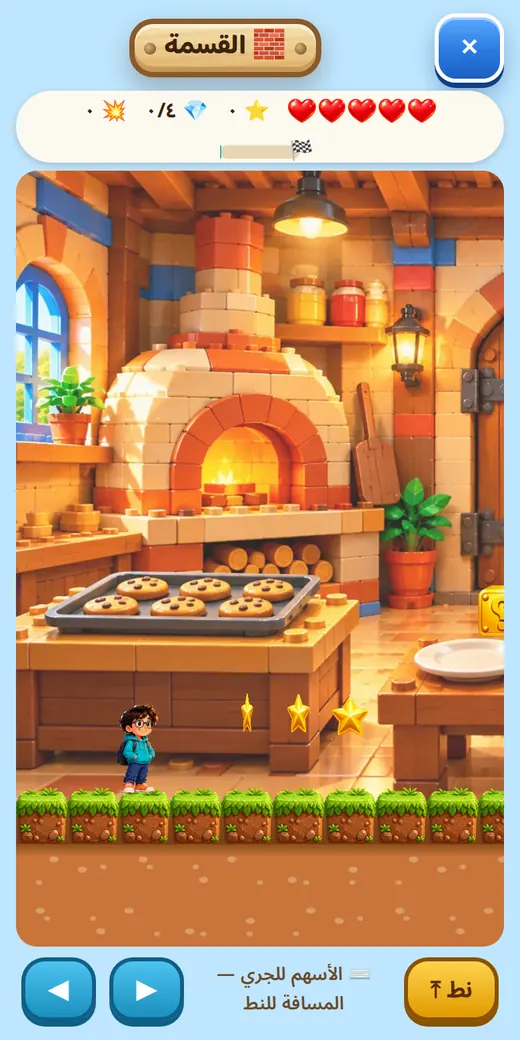
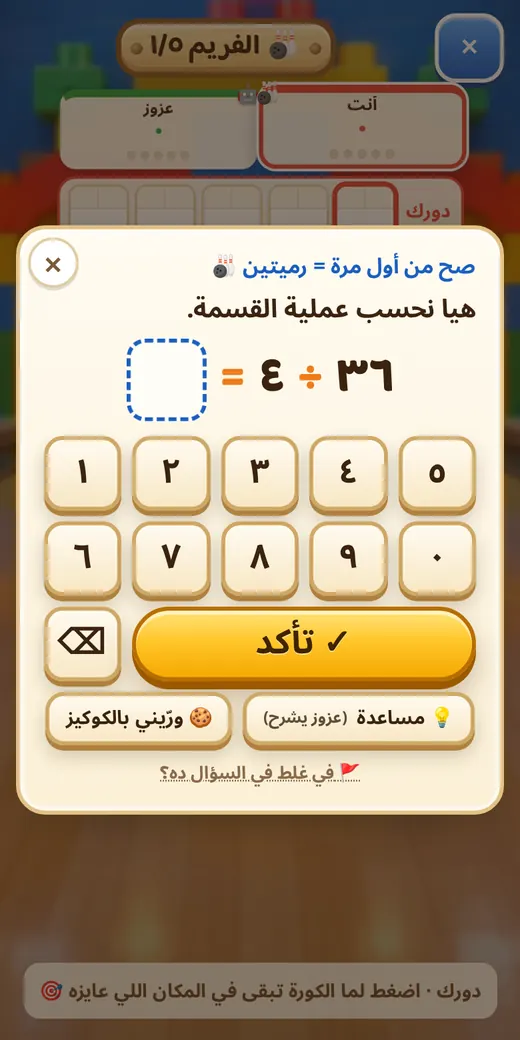
Every lesson has the book's own questions, played as the game the child picks: the adventure, bowling, snakes & ladders, the Maths Train, Azzouz's Machine, the seesaw, Azzouz's clock, memory cards, and for division the Cookie Shop and Frog Jumps. A wrong answer opens help with the book's rule, step by step.

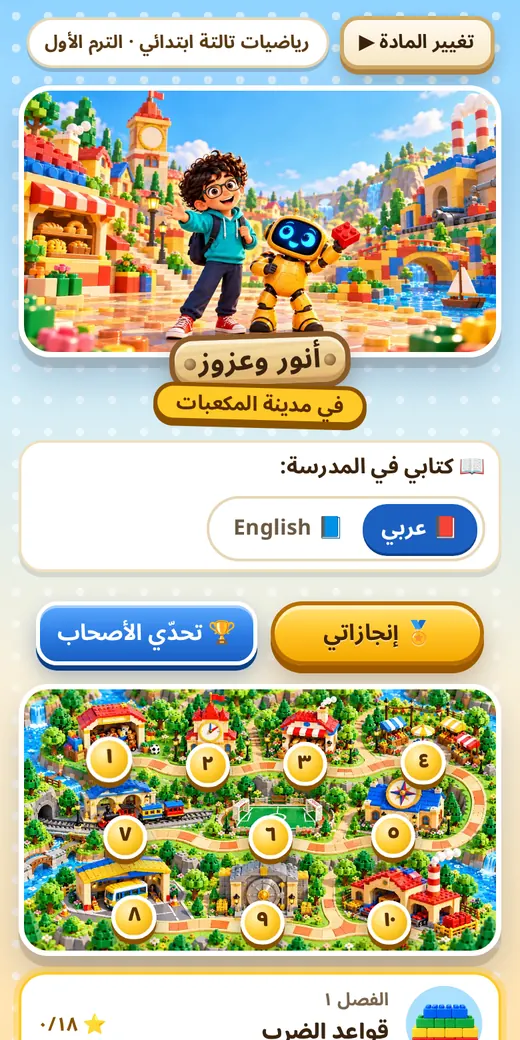
The City of Blocks — Grade 3 Math game
The City of BlocksA map of the 10 chapters
The adventure — Grade 3 Math game
The adventureEvery «?» block is a book question
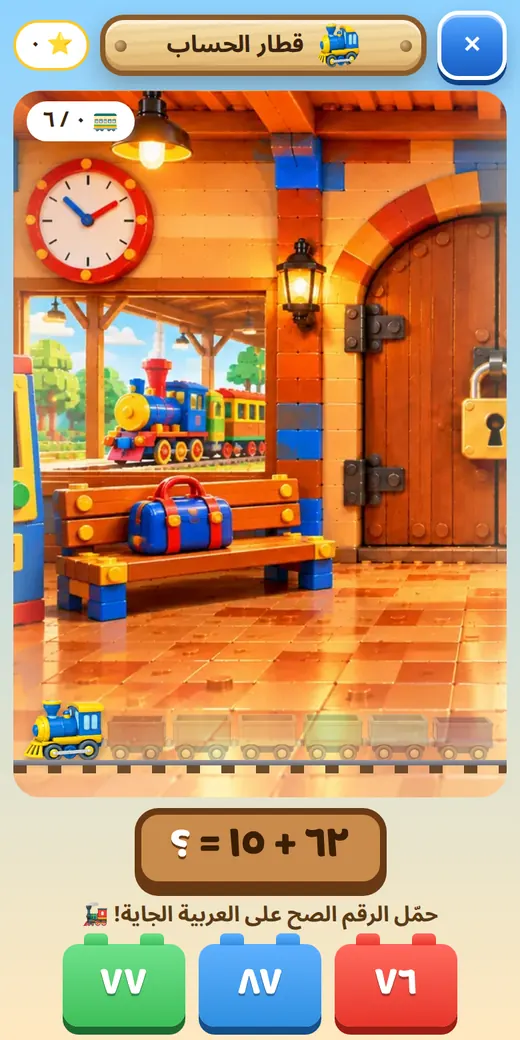
Maths Train — Grade 3 Math game
Maths TrainLoad the carriages with the right answers
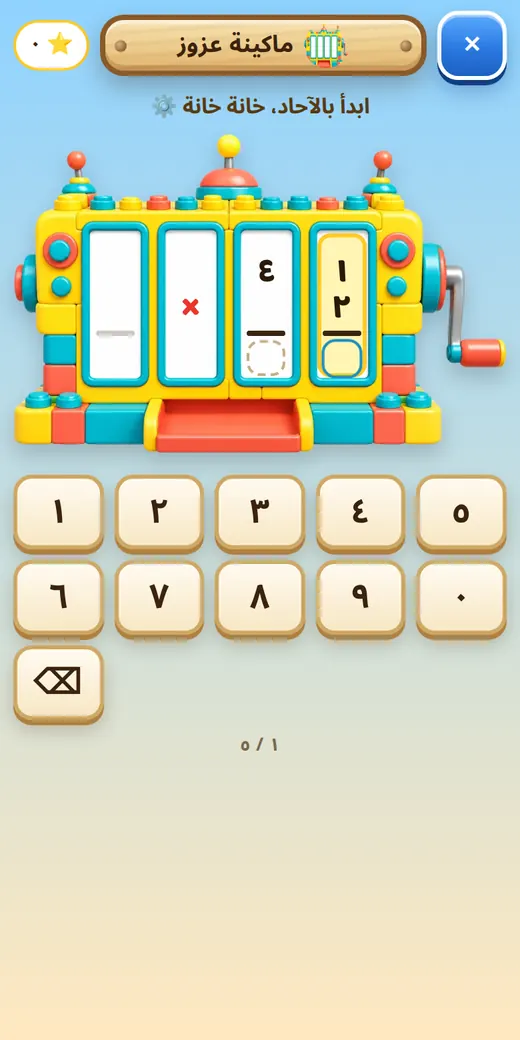
Azzouz's Machine — Grade 3 Math game
Azzouz's MachineVertical sums, column by column
Bowling — Grade 3 Math game
BowlingA question before every roll

Questions from parents 💬

Is it free?

Yes. Completely free, no sign-up, and no ads inside the game.

Is it based on the school book?

Yes. Every question comes from the Egyptian Ministry of Education Grade 3 Math book, Term 1, and every lesson shows its pages in the book.

Is there an English (Languages schools) version?

Yes. The child picks the book used at school: 📕 Arabic or 📘 English. Each one uses its own book's words and numbers, and you can switch any time.

Which games are there?

The adventure, bowling, snakes & ladders, the Maths Train, Azzouz's Machine, the seesaw, Azzouz's clock, memory cards, and for division the Cookie Shop and Frog Jumps.

Does it have other subjects?

Yes. The same game has Grade 3 Arabic, and the child can switch subjects any time.

Does it have English too?

Yes. The same game has Grade 3 English, lesson by lesson from the Ministry book, with every word spoken and a small Arabic line for parents.

Does it work on a phone?

Yes, on any phone, tablet or computer. You can add it to the home screen like an app, and it works offline after the first visit.