🔬 Grade 6 Science · Term 1 · Egyptian curriculum

Grade 6 Science games, Term 1: The Amazing Capsule

Children ride the Amazing Capsule with Anwar and Azzouz and shrink inside the body and the plant: put out and relight the candle, travel with food through digestion, deliver oxygen in the blood and follow water up a plant — every step a hands-on game followed by a question from the book. All 10 chapters of the Grade 6 Science book (Term 1, Egyptian curriculum), lesson by lesson, in English or Arabic — every step in simple words, then a question from the book, and stars at the end.

22 missions10 chapters250+ questions📘 English + 📕 ArabicFree 💙📴 Works offline
🌍 And Grade 6 Social Studies and Arabic too ›

The book, lesson by lesson 📚

Every lesson of the English book, in order: its first sentence, the mission and its stops, and examples of the book questions in the game (tap a question to see its answer). The game has the Arabic book too.

Chapter 1: Conditions for Burning شروط الاحتراق

Lesson 1-1: How Things Burn and AirBook pages 6–7 · 7 questions in the gameالهواء واحتراق الأشياء

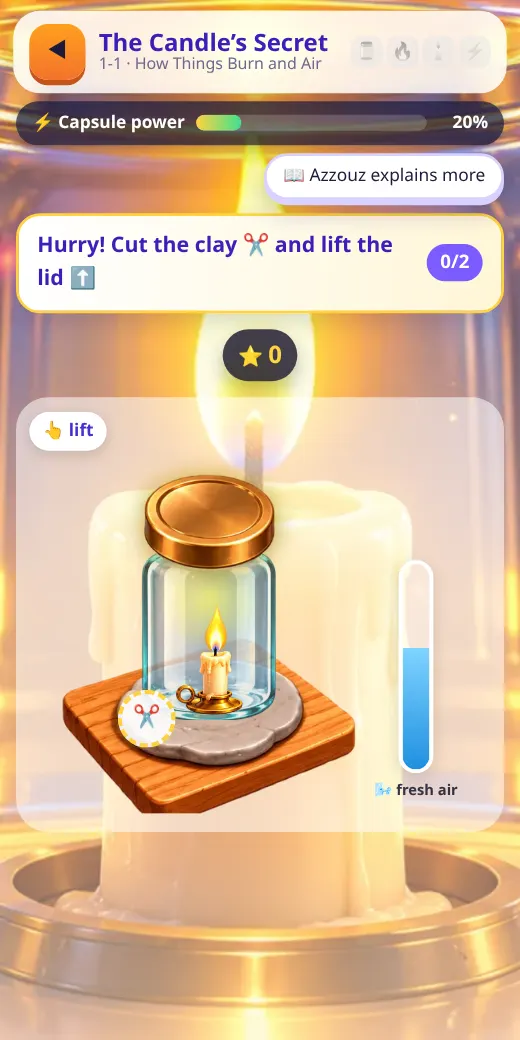
💡 For things to keep burning, fresh air must constantly flow in and out. In a place where the air is not replaced, things cannot keep burning and can be explained by the experiment of burning a candle inside a glass jar.

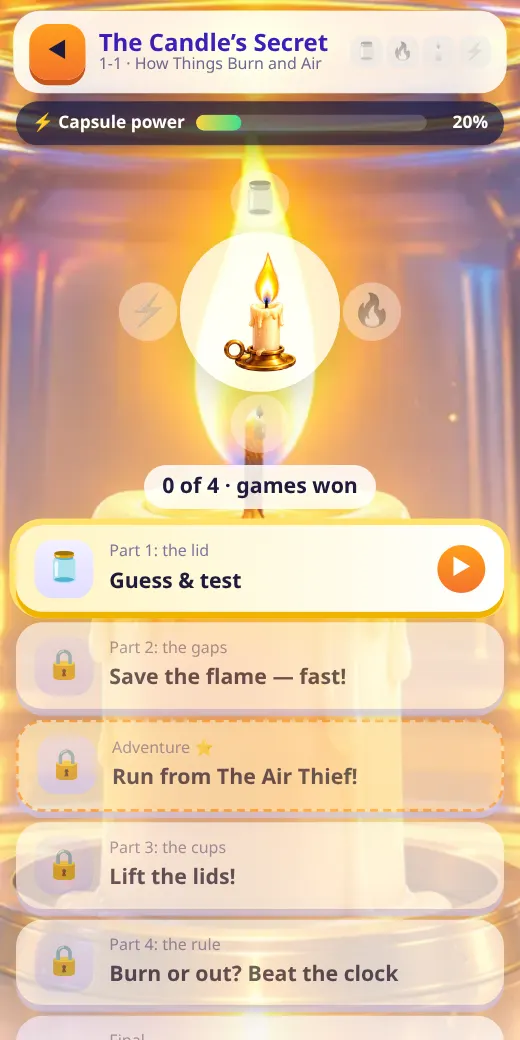
🚀 The mission: “The Candle’s Secret” — 🫙 Guess & test, 🔥 Save the flame — fast!, 🕯️ Lift the lids!, ⚡ Burn or out? Beat the clock

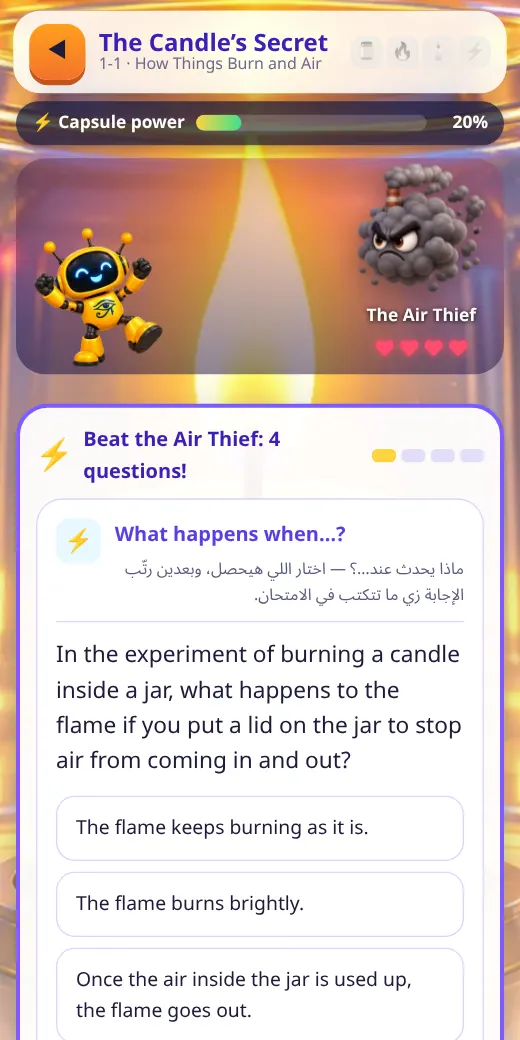
Why did the flame go out inside the jar with the lid?
Answer: Because the air inside the jar has not renewed.
In the experiment of burning a candle inside a jar, what happens to the flame if you leave gaps at the top and bottom of the jar?
Answer: It keeps burning.
Play this lesson ›

Lesson 1-2: The Role of OxygenBook pages 8–11 · 10 questions in the gameدور الأكسجين

💡 Air is a mixture of gases like nitrogen, oxygen, and carbon dioxide.

🚀 The mission: “The Gas Tryouts” — 🫙 Catch the gas — 3 at once, 🔥 Guess & test: the fire tryout, 🥧 Air pie: stop on the line, 🫧 Feed the flame — fast!

What gas is included in the air and has the power to help things burn?
Answer: Oxygen
What happens to the burning incense stick when you put it into a jar of oxygen?
Answer: It burns brightly.
What happens to the burning incense stick when you put it into a jar of carbon dioxide?
Answer: The flame goes out.
Play this lesson ›

Lesson 1-3: Air After BurningBook pages 12–14 · 17 questions in the gameالهواء بعد الاحتراق

💡 When things burn, a part of the oxygen in the air is used, and carbon dioxide is produced.

🚀 The mission: “The Limewater Spy” — 📊 Guess & test: before and after, 🧪 Set the spy trap, 🕵️ Spy hunt — fast!, 🕯️ Domino chain: why did it go out?

After things burn, what gas has increased in the surrounding air?
Answer: Carbon dioxide
After things burn, what gas has decreased in the surrounding air?
Answer: Oxygen
The scientific term: The colorless and clear liquid used to check if there is carbon dioxide.
Answer: Clear limewater
Play this lesson ›

Chapter 2: Respiration التنفس

Lesson 2-1: How does respiration occur?Book pages 18–19 · 11 questions in the gameكيف يحدُث التنفس؟

💡 People inhale and exhale to obtain the oxygen from the air and get rid of carbon dioxide.

🚀 The mission: “The Breath Test” — 🫁 In and out — keep the beat, 🛍️ Guess & test: the two bags, 📟 Gas meter: beat the clock

What gas do we take into our body when we breathe in?
Answer: Oxygen
When comparing the air we breathe in and the air we breathe out, which gas increases in the air we breathe out?
Answer: Carbon dioxide
What happens to limewater when you blow breathed-out air into it?
Answer: It turns milky white.
Play this lesson ›

Lesson 2-2: How Lungs WorkBook pages 20–23 · 12 questions in the gameكيف تعمل الرئتان؟

💡 The air enters from the nose and mouth then passes through the trachea to reach the left and right lungs in the chest.

🚀 The mission: “The Air Trip” — 👃 The air road — fast!, 🔄 Swap station: beat the train, ❤️ Heart rhythm, 🐟 Fish rush

What is the name of the organ where the exchange of oxygen and carbon dioxide takes place?
Answer: Lungs
Which statement correctly explains gas exchange in the lungs?
Answer: It takes in oxygen from the air into the blood.
What carries the oxygen taken in by the lungs to the whole body?
Answer: Blood
Play this lesson ›

Chapter 3: Digestion الهضم

Lesson 3-1: Where Food GoesBook pages 24–25 · 10 questions in the gameأين يذهب الطعام؟

💡 Breaking down food with teeth and changing it into a form that is easy to absorb is called digestion.

🚀 The mission: “The Bite’s Journey” — 🦷 Chomp on time, 🛝 Fix the slide — fast!, 🚪 Door keeper vs the clock

The scientific term: The process of changing food into a form that is easy to absorb into the body.
Answer: Digestion
The scientific term: The path of food from the mouth to the anus.
Answer: Digestive tract (canal)
Food enters the pharynx through the esophagus.
Answer: False ✘
Play this lesson ›

Lesson 3-2: The function of salivaBook pages 26–29 · 11 questions in the gameوظيفة اللُّعاب

💡 Saliva in the mouth has the function of breaking down starch contained in food (like rice or bread) and starch is changed into another substance that is easy for the body to digest by saliva.

🚀 The mission: “The Saliva Scissors” — 🧪 Set up & hit 40°C, 🔍 Track the saliva tube, 💧 Juice ride: 3 laps

The scientific term: A liquid contained in the body, like saliva, that breaks down food.
Answer: Digestive juice
In the experiment to check the function of saliva, why do you warm the test tubes in hot water of about 40 degrees Celsius?
Answer: To make it about the same temperature as inside the body.
After mixing saliva and starch and warming it, did the color change when you added the iodine solution?
Answer: It did not change.
Play this lesson ›

Lesson 3-3: How does absorption occurBook pages 30–33 · 12 questions in the gameكيف يتم الامتصاص؟

💡 The nutrients from digested food are mainly absorbed in the small intestine along with water.

🚀 The mission: “The Villi Towel” — 🧺 Guess & test: spill patrol, 🧽 Grab it — fast!, 🚚 Liver pantry: beat the clock

The scientific term: The small bumps on the inner wall of the small intestine that absorb nutrients.
Answer: Villi
What carries the absorbed nutrients to all parts of the body?
Answer: Blood vessels
Where do the nutrients absorbed in the small intestine pass through first to be carried to the whole body?
Answer: Liver
Play this lesson ›

Chapter 4: Blood Circulation and Excretion الدورة الدموية والإخراج

Lesson 4-1: Heart and BloodBook pages 34–37 · 18 questions in the gameالقلب والدم

💡 Nutrients absorbed from the small intestine and oxygen taken in by the lungs are carried to the whole body by the blood.

🚀 The mission: “The Heart Pump” — ❤️ Guess & test: keep the beat, ⏱️ Guess & test: count the pulse, 🚚 Load the trucks — fast!, 🔁 Drive the loop: beat the clock

The scientific term: The organ that works like a pump to send blood to the whole body.
Answer: Heart
Oxygen is one of the important things that blood carries to the whole body.
Answer: True ✔
Carbon dioxide is one of the important things that blood carries to the whole body.
Answer: False ✘
Play this lesson ›

Lesson 4-2: How the Kidneys WorkBook pages 38–39 · 11 questions in the gameكيف تعمل الكليتان؟

💡 Waste products (unnecessary things produced in the body) are carried to the kidneys by the blood.

🚀 The mission: “The Cleaning Factory” — 🫘 Guess & test: the strainers, 🧹 Clean the blood — fast!, 🎈 Two jobs at once

The scientific term: The organ that filters the blood and filters out waste products.
Answer: Kidney
The scientific term: The liquid waste produced by the kidneys.
Answer: Urine
Which statement correctly explains how the kidneys work?
Answer: It takes out waste products from the blood.
Play this lesson ›

Lesson 4-3: Various OrgansBook pages 40–43 · 7 questions in the gameأعضاء مختلفة

💡 In our body, many organs are lined up closely without gaps, and they work together each other.

🚀 The mission: “Build the Body” — 🫁 Chest or abdomen?, 🧩 Stack the abdomen, 🦴 The back side, 🛣️ The team roads

Among the following organs, which one has one on each side of the backbone, for a total of two?
Answer: Kidneys
Which statement correctly describes where the organs are located?
Answer: The stomach is connected to the esophagus (food pipe).
Each organ is not moving separately, but all are connected by ____ and work together.
Answer: blood vessels
Play this lesson ›

Chapter 5: Photosynthesis البناء الضوئي

Lesson 5-1: Sunlight and StarchBook pages 46–49 · 20 questions in the gameضوء الشمس والنشا

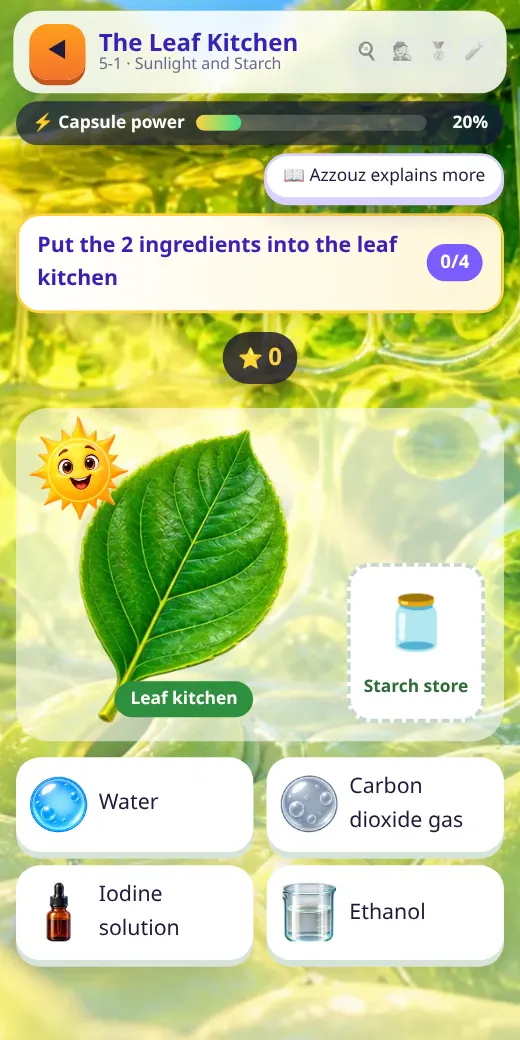
💡 When sunlight falls on the leaves, the plant performs photosynthesis; it uses water and carbon dioxide gas to make its food (sugar), and stores part of it in the form of starch needed for growth.

🚀 The mission: “The Leaf Kitchen” — 🍳 Cook in the leaf, 🕵️ Iodine detective, 🥈 Wrap the leaves, 🧪 The starch test

What nutrient is produced when sunlight falls on the leaves of plants?
Answer: Starch
Choose the correct answer: What color does a leaf that was in the sunlight turn when dipped in iodine solution?
Answer: Dark blue
In the experiment to check if sunlight is needed to produce starch, what is the condition you change?
Answer: Whether the leaf gets sunlight or not
Play this lesson ›

Lesson 5-2: Gas ExchangeBook pages 50–53 · 15 questions in the gameتبادل الغازات

💡 When sunlight is hitting the leaves, plants take in carbon dioxide and release oxygen.

🚀 The mission: “Plant Day & Night” — ☀️ The day shift, 🫁 Plants breathe too, 🌙 The night shift

What gas do plants release into the air when they are in the sunlight?
Answer: Oxygen
Choose the correct answer: What gas do plants take in from the air when they breathe?
Answer: Oxygen
Choose the correct answer: During the night, when there is no light, what kind of gas exchange do plants do?
Answer: Take in oxygen and release carbon dioxide (breathing).
Play this lesson ›

Chapter 6: Transportation of Water in Plants انتقال الماء في النبات

Lesson 6-1: TranspirationBook pages 54–55 · 12 questions in the gameالنتح

💡 Some of the water absorbed from the roots goes out into the air from the leaves.

🚀 The mission: “The Plant Sweats” — 🛍️ Guess & test: the bags, 💨 Catch the sweat — fast!, 🔍 Guard the exits vs the clock

The scientific term: The process when the water inside a plant changes into water vapor and is released from the leaves.
Answer: Transpiration
In the experiment to check that water comes out of the leaves, what is the reason why water drops formed inside the plastic bag?
Answer: Because water vapor came out of the leaves and changed into water.
The scientific term: Small pores, mostly on the lower surface of leaves, that act as exits for water vapor.
Answer: Stomata
Play this lesson ›

Lesson 6-2: The Path of WaterBook pages 56–59 · 13 questions in the gameمسار الماء

💡 If you water the base of a wilted plant, the plant recovers after a while.

🚀 The mission: “The Water Lift” — 🥀 Save the plant — aim low!, 🔴 Guess & test: red water, 🛗 The water lift vs the clock

When a plant is wilted, what should you do to recover it?
Answer: Water the base of the plant
A plant is placed in red colored water. The first plant parts to be colored red are the ____.
Answer: Roots
Choose the correct answer: The part responsible for water absorption is …
Answer: Roots
Play this lesson ›

Chapter 7: Food Chain السلسلة الغذائية

Lesson 7-1: Food ChainBook pages 62–63 · 29 questions in the gameالسلسلة الغذائية

💡 The relationship between eater-and-eaten (the feeding among living organisms) is called a food chain.

🚀 The mission: “Who Eats Whom?” — 🐸 Eater or eaten? Time the lick, ☀️ Sunshine kitchen: cloud attack, 🍽️ Feeding time vs the clock, 🔗 Link the chain — fast!, ⚡ Energy relay: 3 laps

The scientific term: What do we call the food relationship between living organisms?
Answer: Food chain
Choose the correct answer: What kind of living organisms are the beginning of the food chain?
Answer: Plants that produce nutrients using sunlight
Choose the correct answer: Which statement correctly explains the food chain?
Answer: Food chains start with Plants, because they make their own food.
Play this lesson ›

Lesson 7-2: Living Organisms, Air, and WaterBook pages 64–67 · 11 questions in the gameالكائنات الحية والماء والهواء

💡 Connection of living organisms through air

🚀 The mission: “Air & Water Go Round” — 🎁 The gift swap — fast!, 🌧️ Make it rain: catch the order, 🌳 Guard the trees

What gas do animals breathe out and plants take in?
Answer: Carbon dioxide
Choose the correct answer: What do we call the process where plants release water absorbed from their roots into the air as water vapor?
Answer: Transpiration
The water on Earth is changing its shape and keep ____, and it is used repeatedly by many living organisms.
Answer: circulating
Play this lesson ›

Chapter 8: Food Chains in Egypt السلاسل الغذائية في مصر

Lesson 8-1: Desert and Nile Food ChainsBook pages 68–70 · 7 questions in the gameالسلاسل الغذائية في الصحراء ونهر النيل

💡 Egypt has completely different food chains in aquatic environments (the Nile River) and arid areas (deserts).

🚀 The mission: “Nile or Desert?” — 🗺️ Send them home — fast!, 🐊 Feed the Nile: beat the clock, 🏜️ The desert relay, 👑 Crown and seed

Give one example of a top carnivore at the top of the food chain in the Nile River.
Answer: Nile crocodile
Choose the correct answer: Which statement correctly explains the food chains in Egypt?
Answer: In the desert, fennec foxes eat small animals like jerboas.
Give one example of a herbivore that eats plants in the desert food chain.
Answer: Jerboa
Play this lesson ›

Chapter 9: Properties of Solutions خصائص المحاليل

Lesson 9-1: Grouping SolutionsBook pages 74–75 · 13 questions in the gameتصنيف المحاليل

💡 Solutions may look similar, but they differ in their properties. Solutions can be divided into 3 groups by how they change the color of litmus paper.

🚀 The mission: “The Litmus Detective” — 🕵️ Guess & test, 🧪 The line-up — beat the clock, 🥢 Lab rush: clean rod

Choose the correct answer: Which of the following represents the correct litmus paper reaction?
Answer: An alkaline solution turns red litmus paper blue.
What are some neutral solutions? Choose one example.
Answer: Salt water
What type of solution turns blue litmus paper red?
Answer: Acidic
Play this lesson ›

Lesson 9-2: What is dissolved in solutionsBook pages 76–79 · 15 questions in the gameما الذي يذوب في المحاليل؟

💡 By evaporating a solution, we can find out what was dissolved inside.

🚀 The mission: “The Hidden Treasure” — 🥽 Heat it safely — fast!, 🔥 Guess & test, 💎 Stays or flies? Beat the clock

What is the white solid left at the bottom of the container when salt water was evaporated?
Answer: Salt
Choose the correct answer: Why is nothing left at the bottom of the dish when dilute hydrochloric acid was evaporated?
Answer: Because what was dissolved escaped as a gas.
Choose the correct answer from below. What should you be careful of in the experiment to evaporate a solution?
Answer: Turn off the heat when there is only a little solution.
Play this lesson ›

Chapter 10: Reaction between Solutions and Metals تفاعل المحاليل مع الفلزات

Lesson 10-1: Aqueous Solutions and MetalsBook pages 82–83 · 8 questions in the gameالمحاليل المائية والفلزات

💡 Some aqueous solutions have the properties that enable it to react with metals.

🚀 The mission: “Metal Bubbles” — ✨ Shine and knock — quick!, 🥽 Gear up — fast & safe, 🫧 Catch the proof

Choose the correct answer: Which statement correctly explains the properties of aqueous solutions that react with metals?
Answer: Hydrochloric acid can react with aluminum and iron.
Some aqueous solutions have the properties that enable it to react with ____.
Answer: metals
Metals are shiny materials with a luster, and most of them are ____.
Answer: solid
Play this lesson ›

Lesson 10-2: What is Left After EvaporationBook pages 84–87 · 16 questions in the gameماذا يتبقى بعد التبخير؟

💡 When you evaporate the liquid resulted from aluminum that reacted with dilute hydrochloric acid, a white solid appears.

🚀 The mission: “The Metal Changed!” — 🔥 Guess, dry, wait, 🔎 Unmask the impostor, 🦋 Before or after? Beat the fuse

The powder left after evaporating the dilute hydrochloric acid with which aluminum reacted is the same as the original aluminum.
Answer: False ✘
Choose the correct answer: What is left when you heat the dilute hydrochloric acid with which aluminum reacted in an evaporating dish?
Answer: A white solid that is not a metal
Choose the correct answer: What happens when you pour dilute hydrochloric acid again on the powder remaining after evaporation?
Answer: No bubbles are produced.
Play this lesson ›

How do they play? 🎲

Every lesson is a mission: stops open in order; at each one Azzouz explains the idea simply, the child plays it with their own hands (points, combos and a record to beat), wins a key 🔑 and answers a book question. In the middle “Run from the monster!” to collect stars, and at the end the big challenge with the lesson questions and stars ⭐. A wrong answer shows the book sentence with the answer. “📝 Exam practice” has the book’s question types, and in “🤝 Who’s the best scientist?” they pick chapters and play a quiz, chess or bowling with Azzouz or friends.

Mission map — Grade 6 Science game
Mission mapStops open in order
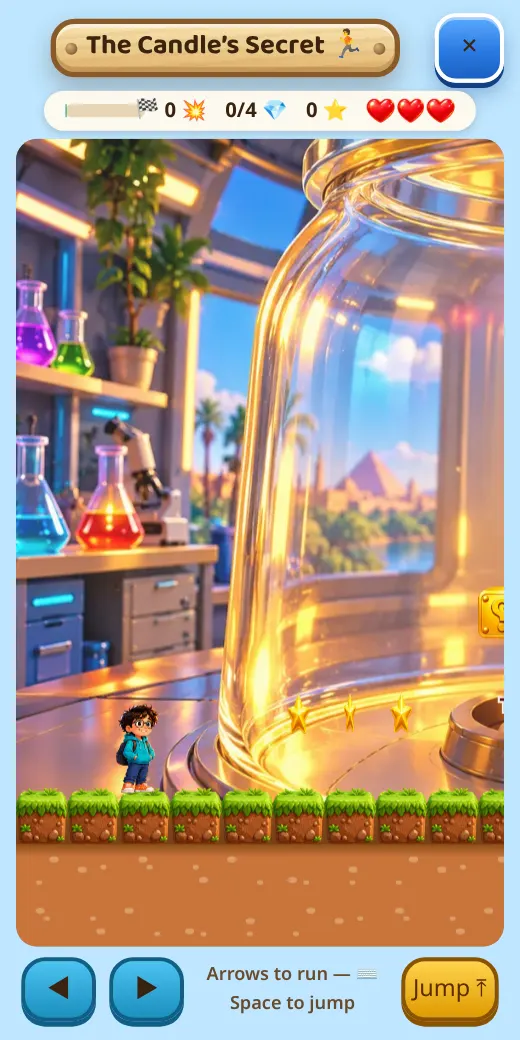
The Candle’s Secret — Grade 6 Science game
The Candle’s SecretSave the flame before the air runs out
A stop game — Grade 6 Science game
A stop gamePoints, combos and a record to beat
Run from the monster! — Grade 6 Science game
Run from the monster!Run, stars and lesson questions
The big challenge — Grade 6 Science game
The big challengeBeat the monster with lesson questions
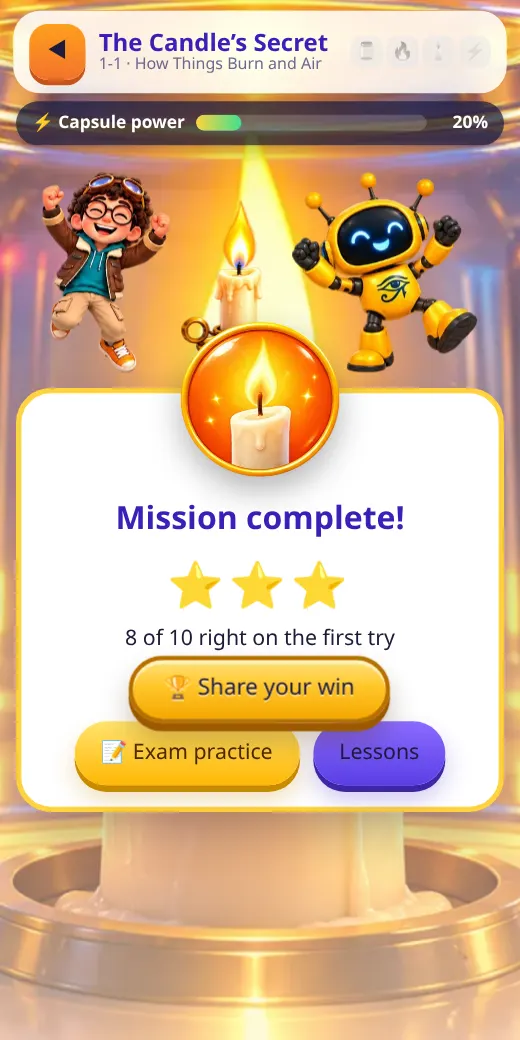
Mission complete! — Grade 6 Science game
Mission complete!Stars and a win picture to share

Parents’ questions 💬

Is it free?

Yes, completely free, no sign-up, and no ads inside the game.

Are the questions from the Ministry book?

Yes. Every question and every fact comes from the Grade 6 Science book, Term 1, and the Ministry assessment book, with the book pages next to every lesson.

English or Arabic book?

Both. Children pick the book they study at school — 📘 English (Languages schools) or 📕 Arabic — and can switch any time. Every English line has a small Arabic line under it for parents.

What is a “mission”?

Every lesson is a story with Anwar and Azzouz in “The Amazing Capsule”: stops that open in order, each with a simple explanation and a hands-on game (put out and relight a candle, travel through digestion, deliver oxygen in the blood, follow water up a plant), then a book question. In the middle a run from the monster to collect stars, and at the end the big challenge with the lesson questions.

Do they learn a fact before they are asked it?

Yes. Every fact is told in the story before any game or question needs it, so children don’t need to have read the book first.

What is “Who’s the best scientist?”

Pick the chapters, then play a quick-fire quiz against Azzouz or a friend (same phone or online with a code), or science chess or bowling. Winners can share a picture of their win.

Can parents follow progress?

Yes, the “👨‍👩‍👧 Parents & teachers” page shows stars, lessons to revise, the questions answered wrong with the book sentence, and a report to send on WhatsApp. Every question has “🚩 Something wrong in this question?”.

Does it work on phones?

Yes, on any phone, tablet or computer. Add it to the home screen like an app and it works offline (except online play).