 Anwar & Azzouz


Lesson 1-1: Big NumbersBook pages 3–4 · 1 question in the gameالأعداد الكبيرة
💡 I can identify all whole number place values through the One Milliard place. A digit's location in a number affects its value.
Free games for the whole Grade 4 Math book (Term 1, Egyptian curriculum), in English or Arabic: all 8 units, lesson by lesson, with the book's own questions, plus Azzouz's paper pad for long sums.
Every lesson of the English book, in order: the lesson’s idea in the book’s words and examples of the game’s questions (tap a question to see its answer). The game has the Arabic book too.
💡 I can identify all whole number place values through the One Milliard place. A digit's location in a number affects its value.
💡 I can explain how the value of a digit changes as it moves to the left in a number. As a digit moves one space to the left on the place value chart, its value = 10 times.
💡 I can write numerals in standard, word, and expanded forms.
💡 I can build and break down numerals in multiple forms.
💡 I can use symbols and place value to compare large numerals. If the first digit is the same in both numerals, compare the next place value.
💡 I can compare numbers in multiple forms (standard, expanded, word and decomposed form) and describe the strategies I use.
💡 I can order numbers in multiple forms. Ascending = from least to greatest; descending = from greatest to least.
💡 I can use multiple strategies to round numbers (midpoint strategy, Rounding Rule). Circle the digit; look at the digit to its right: 5 or higher → add one; 4 or less → leave it alone; replace the digits on the right by zeros.
💡 I can identify and explain the properties of addition: Additive Identity (adding 0), Commutative (order), Associative (grouping with parentheses).
💡 I can add multidigit whole numbers. I can estimate to check the reasonableness of my answer.
💡 I can use place value to help me subtract with regrouping. I can estimate to check the reasonableness of my answers.
💡 I can use letters to represent unknown quantities in equations, use bar models to represent and solve story problems, and solve equations that include variables.
💡 I can solve multistep story problems: answer the hidden question first, then the main question.
💡 I can convert between metric units of length. 1 km = 1,000 m and 1 m = 100 cm (Kilo- = 1,000 units, Centi- = 1/100 unit).
💡 I can convert between metric units of mass. 1 ton = 1,000 kg and 1 kg = 1,000 g.
💡 I can convert between metric units of capacity. 1 L = 1,000 mL.
💡 I can explain relationships between units of time. 1 minute = 60 seconds, 1 hour = 60 minutes, 1 day = 24 hours, 1 week = 7 days.
💡 I can solve elapsed time problems: add or subtract the hours, then the minutes; 60 minutes = 1 hour.
💡 I can add and subtract to solve measurement problems. Use the Steps for Solving Story Problems and change to the same unit first.
💡 I can multiply and divide to solve measurement problems. Draw a picture or model, then change to the unit the question asks for.
💡 I can use formulas to calculate the perimeter of rectangles: P = l + w + l + w or P = (l + w) x 2.
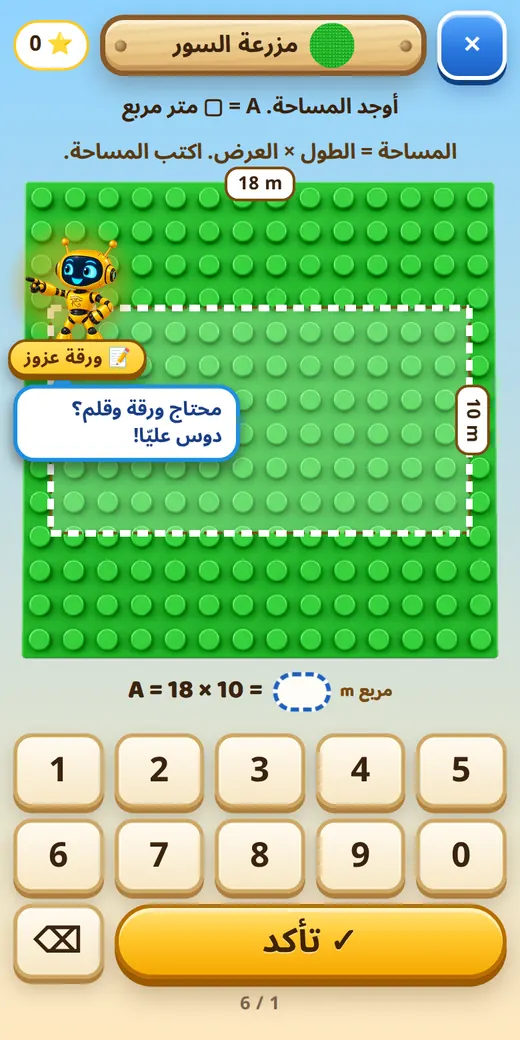
💡 I can use formulas to calculate the area of rectangles: A = L x W.
💡 I can use formulas to calculate unknowns when given some dimensions of rectangles.
💡 I can find the area and perimeter of complex shapes: divide the shape into smaller rectangles or squares.
💡 Multiplicative comparison: multiplication can be used to compare numbers («… is … times greater than …»). Create models (tape diagrams) to show it.
💡 Create multiplication equations to represent comparisons. Use a letter to represent a missing number in a multiplication problem.
💡 Solve a multiplication equation that represents a comparison (find the unknown number).
💡 Commutative Property of Multiplication: changing the order of the factors does not change the product. Apply it to solve problems with and without an unknown number.
💡 Identity Property: a number × 1 = the same number. Zero Property: a number × 0 = 0. Patterns when multiplying by 10, 100, and 1,000.
💡 Associative Property of Multiplication: place parentheses around the factors you will multiply first (rewrite the factors in another order if helpful); the product stays the same.
💡 Use decomposing and the Associative Property of Multiplication to solve equations with multiples of 10, 100, or 1,000.
💡 I can define factors of a whole number. I can identify factors of a whole number. I can explain patterns I observe in numbers that have 2, 5, or 10 as a factor.
💡 I can determine if a number is prime or composite. A prime number has exactly two factors: 1 and the number itself. A composite number has more than two factors.
💡 I can find common factors between two whole numbers. I can identify the greatest common factor between two whole numbers.
💡 I can define multiples of whole numbers. I can identify multiples of whole numbers (skip counting).
💡 I can identify common multiples of two numbers.
💡 I can explain the relationship between factors and multiples. I can determine if a number is a factor or a multiple of another number.
💡 I can use an area model to represent two-digit by one-digit multiplication. I can explain how I use place value to multiply.
💡 I can use an area model to multiply a one-digit number by a whole number with up to four digits, and apply the Distributive Property of Multiplication.
💡 I can use the partial products algorithm to multiply a one-digit number by a whole number with up to four digits.
💡 I can estimate products. I can use the standard algorithm to multiply a one-digit number by a whole number with up to four digits.
💡 I can identify patterns when multiplying two multiples of 10, multiply a two-digit number by a multiple of 10, and check the answer with estimation and mental math.
💡 I can identify the dividend, divisor, and quotient of a division problem. I can explain what a remainder represents in a division problem.
💡 I can use place value, multiplication facts, and patterns with zeros to divide multiples of 10, 100, and 1,000 by one-digit divisors.
💡 I can use area models to represent and solve division problems.
💡 I can use the partial quotients algorithm to solve division problems.
💡 I can estimate quotients using place value and patterns in multiplication and division. I can use the standard algorithm to solve division problems.
💡 I can use properties of place value to accurately record quotients. I can use multiplication to check answers to division problems.
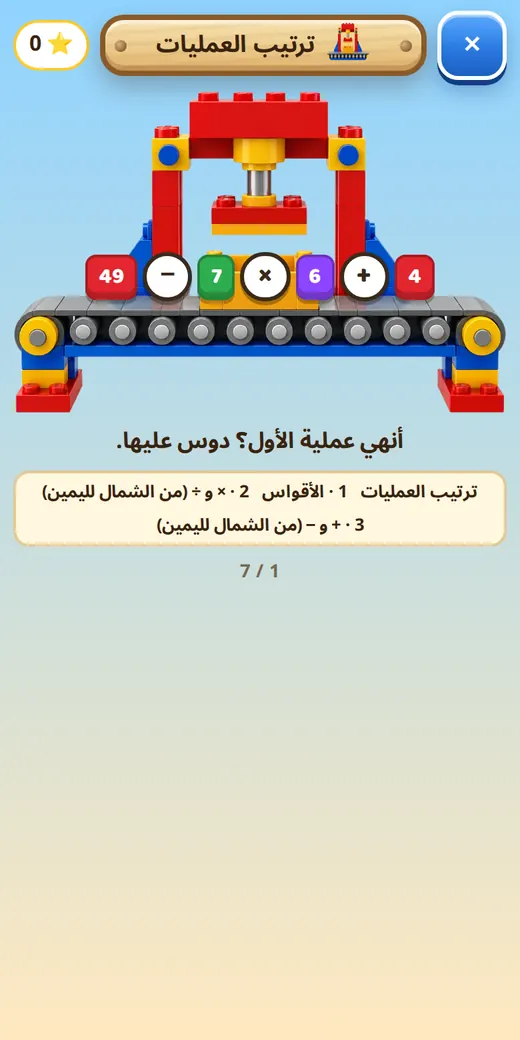
💡 I can use the order of operations to solve problems with multiple operations. Order: Parentheses → Multiplication and Division (left-to-right) → Addition and Subtraction (left-to-right).
💡 I can write and solve an equation to represent what is happening in a multistep story problem. Remember the order of operations.
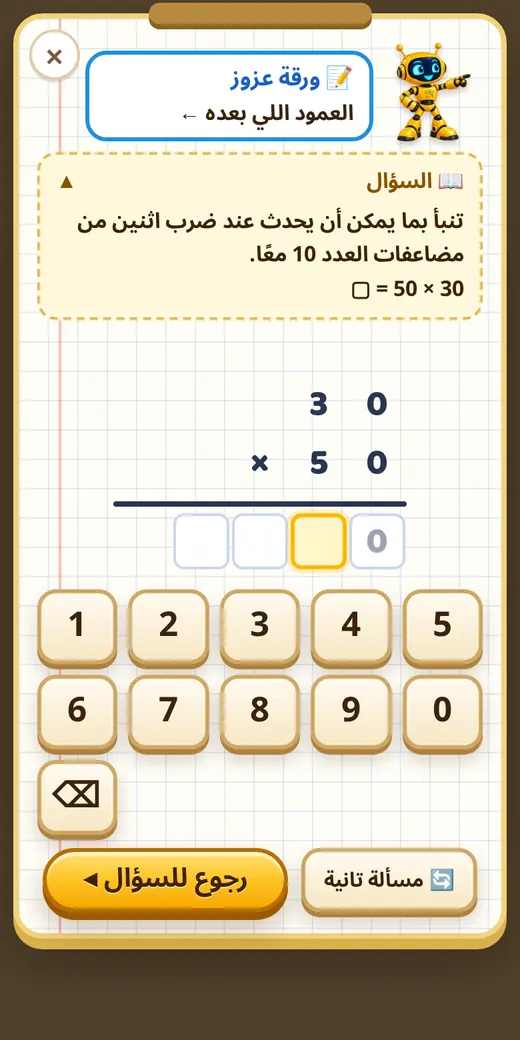
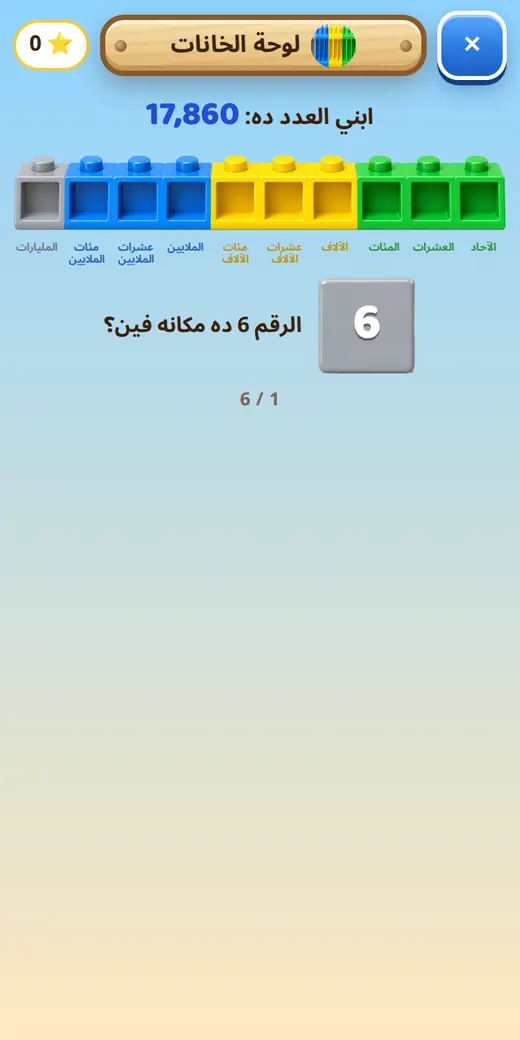
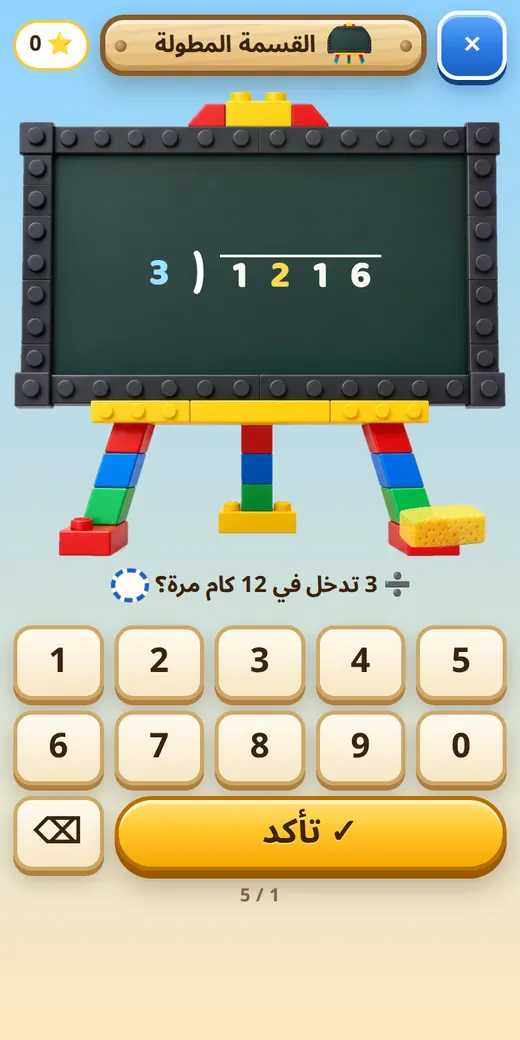
Every lesson has the book's own questions, played as the game the child picks: the adventure, bowling, snakes & ladders, the Place-Value Board, the Bar-Model Bench, the Area & Perimeter Farm, Long Division, Order of Operations, Azzouz's Machine, the seesaw, memory cards and the Maths Train. When a question needs pen and paper, Azzouz pops up: one tap opens squared paper with the question on it, the child works column by column like in a notebook, and carries are added automatically.
Yes. Completely free, no sign-up, and no ads inside the game.
Yes. Every question comes from the Egyptian Ministry of Education Grade 4 Math book, Term 1, and every lesson shows its pages in the book.
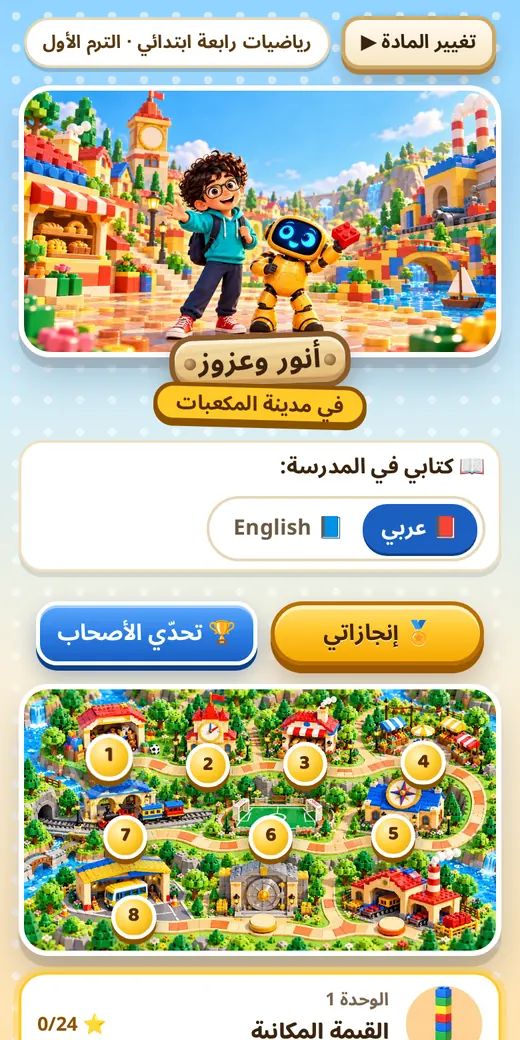
Yes. The child picks the book used at school: 📕 Arabic or 📘 English. Each one uses its own book's words and numbers, and you can switch any time.
The adventure, bowling, snakes & ladders, the Place-Value Board, the Bar-Model Bench, the Area & Perimeter Farm, Long Division, Order of Operations, Azzouz's Machine, the seesaw, memory cards and the Maths Train.
When a question needs pen and paper (long addition, subtraction, multiplication or division), Azzouz floats on the screen. One tap opens squared paper with the question on it; the child works column by column and carries are added automatically. It is a helper only: it never gives away the answer.
Yes. The same game has Grade 4 Arabic, Social Studies and Science, and the child can switch subjects any time.
Yes. The same game has Grade 4 English, lesson by lesson from the Ministry book, with every word spoken and a small Arabic line for parents.
Yes, on any phone, tablet or computer. You can add it to the home screen like an app, and it works offline after the first visit.